Mental health struggles affect roughly 1 in 5 teens, yet many never get help. At The Teen Center, we know that access to care is the biggest barrier-and that’s where online teen therapy options change everything.
Virtual therapy removes the scheduling headaches, transportation issues, and stigma that keep teens from getting support. This guide walks you through what’s available, how to spot a legitimate provider, and what actually works.
What Online Teen Therapy Actually Is
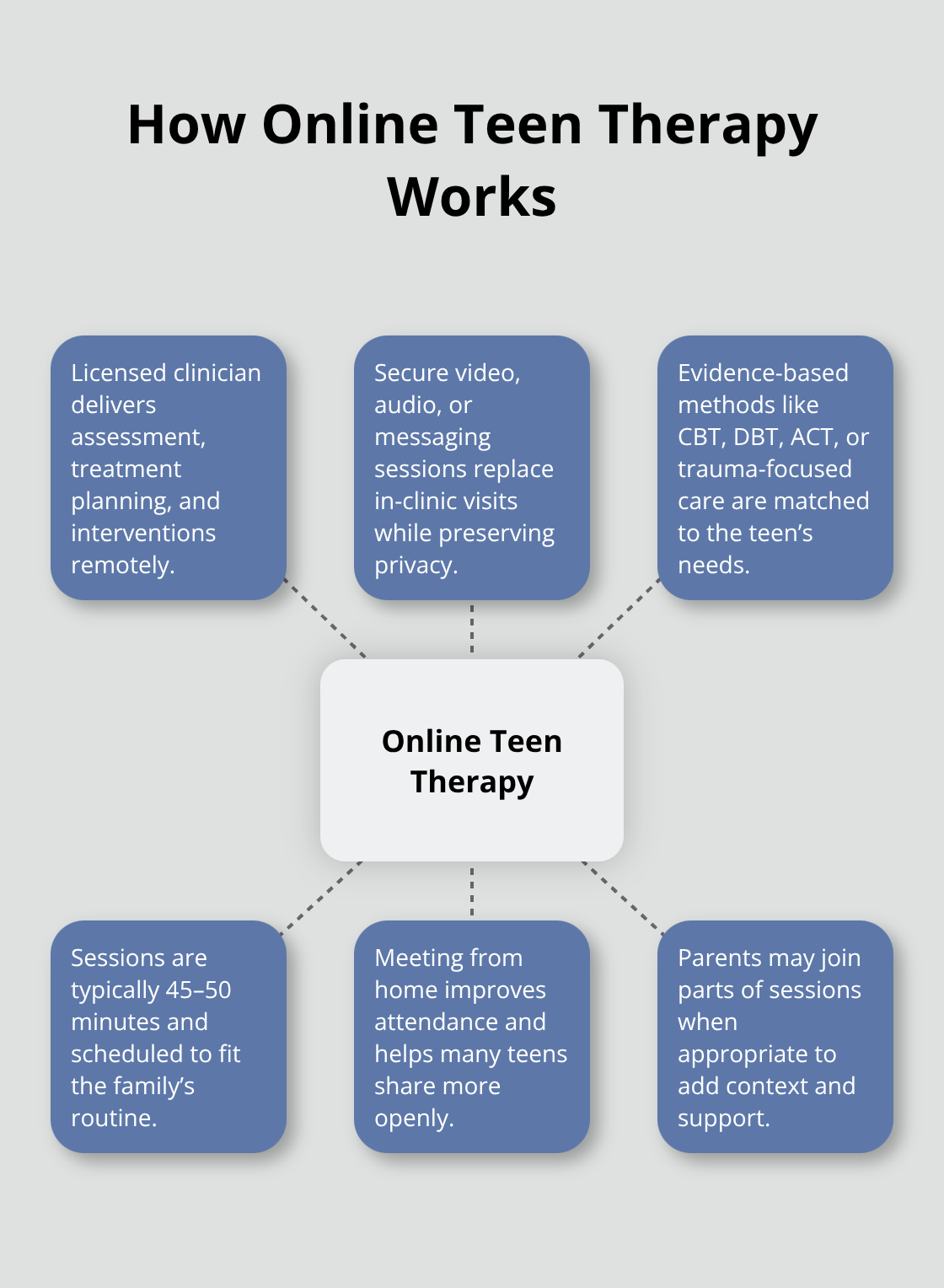
Online teen therapy, or teletherapy, is professional mental health support delivered through secure video, audio, or messaging platforms instead of in-person appointments. A licensed therapist conducts the same clinical work-assessment, treatment planning, evidence-based interventions-but from separate locations. The therapist applies cognitive behavioral therapy, dialectical behavior therapy, or other proven approaches depending on what the teen needs. Sessions typically run 45-50 minutes, just like traditional therapy, and happen on a schedule that works for the family. Your teen sits in your home rather than a clinic waiting room, which changes everything about whether they actually show up and engage.
How effective is online teen therapy compared to in-person care?
Research examining randomized controlled studies found that online interventions for adolescents reduced anxiety symptoms significantly and showed comparable results to face-to-face therapy. The therapeutic relationship-what clinicians call the alliance between therapist and client-holds up just as well on video. A 2014 study by Simpson and Reid found that clients reported similar bond and presence with therapists via videoconferencing as they did in person. What matters most is whether the therapist is qualified and the teen feels heard. Convenience actually helps: teens attend sessions more consistently when there’s no commute, and they often open up more easily from a familiar space. Accessibility drives real engagement.
Platform security is non-negotiable
Any platform your teen uses must be HIPAA-compliant, meaning it meets federal standards for protecting health information. Look for encryption, which scrambles data so only the therapist and your teen can read it. Two-factor authentication (where you need a password plus a code sent to your phone) adds another layer. Some platforms let teens use nicknames instead of their real names, which protects identity. If your teen is in crisis, the platform must have clear instructions to call 988 or access emergency services immediately.
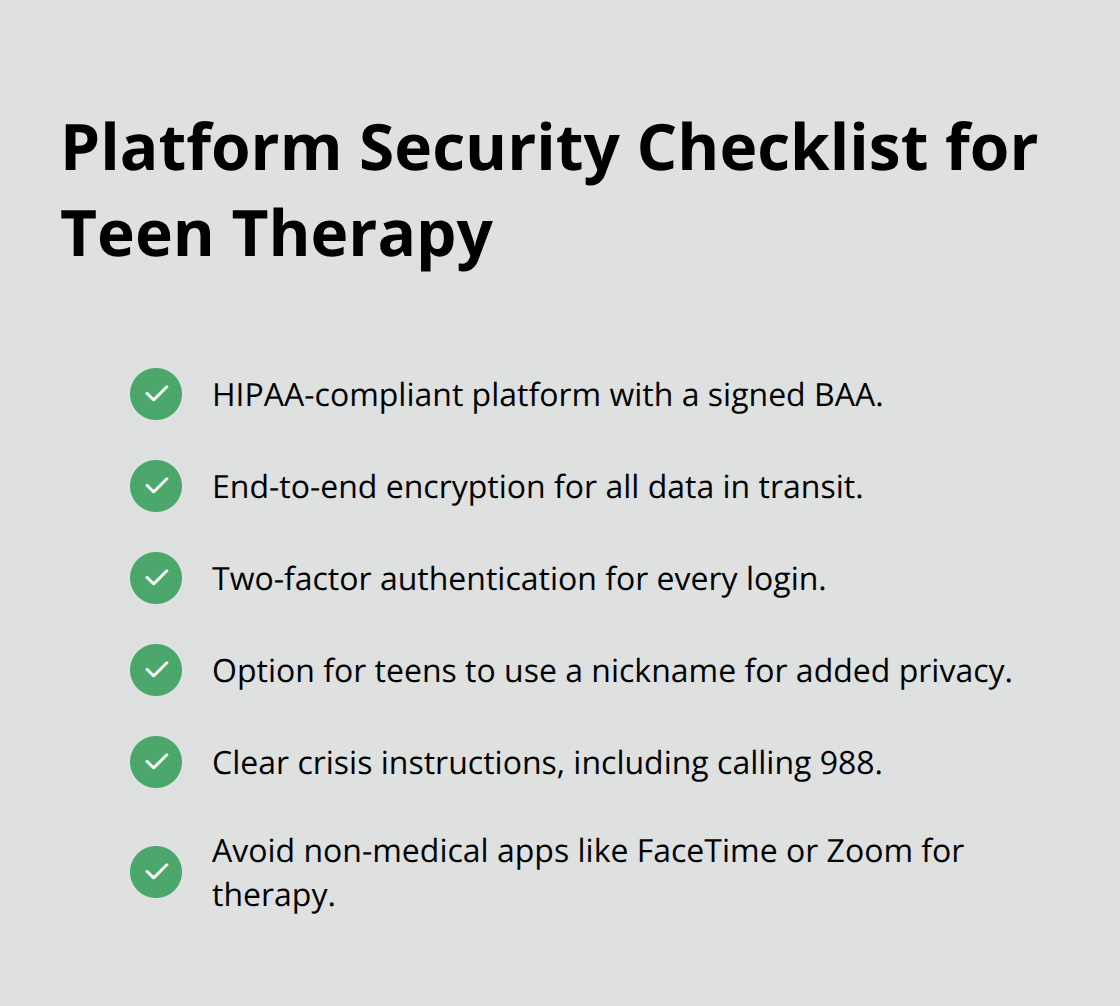
Avoid regular video apps like FaceTime or Zoom for therapy; those aren’t designed for medical privacy and can expose sensitive conversations.
What to expect in your first sessions
The intake process typically takes one to two sessions. The therapist gathers information about your teen’s history, current struggles, and what they hope to change. You may participate in part of this conversation (with your teen’s consent) so the therapist understands the family context. After intake, the therapist proposes a treatment plan with specific goals and the approach they’ll use. Most teens and families know within the first few sessions whether the fit feels right. If it doesn’t, switching to a different therapist is straightforward-many providers match you with someone new within days.
Individual therapy versus family sessions
Individual sessions give your teen a private space to talk without worrying about parental judgment. Family sessions bring everyone together to address patterns that affect the whole household (conflict, communication breakdowns, or how parents can support recovery). Many teens benefit from both: individual work on their own thoughts and feelings, plus family sessions to repair relationships and build understanding. The therapist helps you decide which format makes sense based on what your teen is working through.
What Services Does Online Teen Therapy Offer
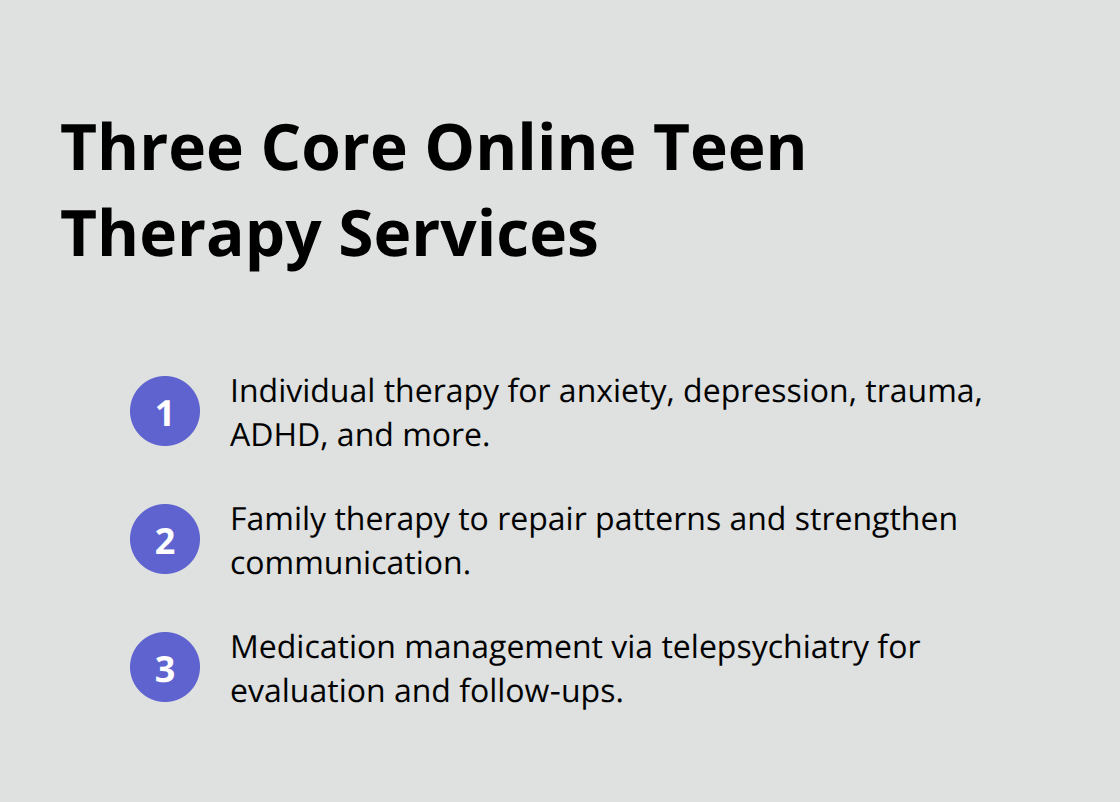
Online teen therapy comes in three primary formats, and matching the right service to your teen’s actual needs matters far more than picking a trendy platform. Individual therapy gives your teen one-on-one time with a licensed clinician to work through anxiety, depression, trauma, ADHD, or whatever brought them to therapy. Family therapy brings parents and teens together to address relational patterns-conflict escalation, communication breakdowns, or how the household responds to one teen’s mental health crisis. Medication management via telehealth lets a psychiatrist or psychiatric nurse practitioner evaluate whether medication makes sense, monitor side effects, and adjust dosages without clinic visits. Most teens benefit from a combination: individual sessions to process their own thoughts, family sessions to rebuild relationships, and medication support when clinical symptoms warrant it. Research from Fischer-Grote and colleagues in JMIR Mental Health found that online interventions reduced adolescent anxiety and depression significantly, with no evidence that one modality outperforms another.
Individual therapy handles the core mental health work
One-on-one sessions let your teen talk freely without worrying about disappointing parents or facing judgment at home. A therapist trained in adolescent care applies cognitive behavioral therapy, dialectical behavior therapy, acceptance and commitment therapy, or trauma-focused approaches depending on diagnosis and preference. Sessions run 45–50 minutes weekly or biweekly, and many platforms allow messaging between sessions so your teen can share urgent thoughts without waiting days. This matters: teens with anxiety or suicidal thoughts need access faster than a weekly appointment schedule allows. Talkspace offers unlimited text messaging to a licensed therapist plus a monthly video session starting at $69 weekly, with many insurance plans covering the cost entirely. If your teen struggles with school avoidance, social isolation, or behavioral problems, individual therapy forms the foundation. The therapist develops a concrete treatment plan with measurable goals-not vague promises of feeling better, but specific changes like attending school four days weekly or reducing panic attacks from five to two per week.
Family sessions repair the household system
When one teen spirals into depression or anxiety, the entire family structure shifts. Parents become hypervigilant, siblings feel neglected, and communication turns into conflict management. Family therapy with a licensed clinician interrupts these patterns. Your teen learns to express needs without attacking, parents learn to validate without enabling, and everyone develops new conflict-resolution skills. Brightline, which operates clinics across New York and online nationwide, emphasizes a family-focused model because mental health problems ripple through households. Sessions typically involve the teen and at least one parent, though some therapists bring in siblings if family dynamics require it. Research shows that family therapy accelerates recovery: teens in family-based interventions show greater reductions in symptoms compared to adolescent-only treatments. Your therapist will recommend family sessions at specific intervals-perhaps one family session monthly alongside weekly individual work, or intensive family therapy during acute crises. Family therapy isn’t optional if your teen lives at home; parents either become part of the solution or they become part of the problem.
Medication management requires a psychiatric provider
Not every teen needs medication, but when they do, finding a psychiatrist or psychiatric nurse practitioner who offers telehealth is genuinely hard. Most therapists cannot prescribe; they can only recommend that you see a psychiatrist. Brightline charges $225–$350 per psychiatry appointment, and many insurance plans cover psychiatric care at similar rates to therapy. The psychiatrist conducts a thorough diagnostic evaluation, reviews your teen’s medical history and any previous medication trials, and discusses whether medication aligns with your family’s values and treatment goals. If your teen starts medication, telehealth psychiatry means follow-up visits happen every four to six weeks instead of requiring monthly clinic trips. Your teen reports side effects or concerns via the platform, and the psychiatrist adjusts the dose or switches medications without unnecessary delay. This matters most for teens on multiple medications or those with complex psychiatric presentations like bipolar disorder or treatment-resistant depression. Medication management works best paired with therapy: the therapist addresses thoughts and behaviors while medication stabilizes mood or reduces anxiety enough for therapy to take hold.
The next step is understanding how to evaluate which provider actually delivers on these services and whether their approach matches your teen’s specific situation.
Spotting a Legitimate Online Therapy Provider
Choosing an online therapy provider means verifying three things before your teen’s first session: the therapist’s actual credentials, whether their treatment approach has research backing it, and whether the platform protects your teen’s privacy. Start by confirming that the therapist holds a current license in your state. Most states require therapists to display their license number publicly, and you can verify it through your state’s licensing board website-look up your state’s psychology, counseling, or social work board and search the therapist’s name. Licensed Clinical Social Workers (LCSWs), Licensed Professional Counselors (LPCs), and psychologists all meet different training standards, but all require supervised hours and passing exams. Talkspace therapists average about 9 years of experience and come from across all 50 states and Canada, which matters because a therapist licensed in one state cannot legally practice in another without additional credentials. If a provider claims to offer therapy but cannot show you a license number or resists verification, that’s a disqualification.
Verify credentials and specialization
Many teens and parents assume that working for a recognizable platform means the therapist is qualified, but platforms vary wildly in screening. Ask directly: How many hours of supervised training did this therapist complete? Have they completed specialized training in adolescent mental health? Do they hold continuing education credentials in evidence-based approaches like cognitive behavioral therapy or trauma-focused CBT? A therapist with 2 years of experience and adolescent specialization outperforms a generalist with 20 years who mostly treats adults. Your teen’s mental health depends on someone who understands how adolescent brains work, not just someone with a license.
Check for evidence-based treatment methods
Evidence-based treatment approaches matter because rigorous research has tested them and proven they work. Cognitive behavioral therapy remains the most researched and effective approach for adolescent anxiety and depression, with meta-analyses showing consistent benefits across dozens of randomized controlled trials. Dialectical behavior therapy (DBT) specifically targets teens with emotional dysregulation, suicidal thoughts, or self-harm behaviors. Acceptance and commitment therapy (ACT) helps teens with anxiety and chronic stress by teaching them to accept difficult thoughts rather than fight them. Trauma-focused CBT is the gold standard for teens who’ve experienced abuse, assault, or other trauma. When you speak with a potential provider, ask which approach they use and why. If they say they use a mix of different techniques without naming specific, evidence-based methods, that’s a red flag. Brightline’s programs for anxiety, OCD, ADHD, and disruptive behaviors are structured around specific evidence-based protocols with measurable outcomes tracked throughout treatment.
Evaluate platform security features
Platform security requires checking three concrete features: HIPAA compliance, encryption, and two-factor authentication. HIPAA compliance means the platform meets federal privacy standards and has signed a Business Associate Agreement with the therapist. Encryption scrambles data so only your teen and therapist can read it. Two-factor authentication requires a password plus a second verification step (like a code texted to your phone) before anyone logs in. Some platforms let teens use a nickname instead of their real name, which adds privacy protection. Ask the provider: Is your platform HIPAA-compliant? Do you use end-to-end encryption? Do you offer two-factor authentication? Can my teen use a nickname? If they cannot answer these questions directly, find a different provider. Your teen’s mental health information is deeply personal, and sloppy security is unforgivable.
Final Thoughts
Selecting the right online teen therapy option requires you to confirm the therapist’s credentials and adolescent specialization, verify that their treatment approach has research backing it, and check that the platform protects your teen’s privacy. A licensed therapist with specific training in adolescent mental health and experience with evidence-based methods like cognitive behavioral therapy or trauma-focused approaches outperforms generalists every time. Platform security is non-negotiable-HIPAA compliance, encryption, and two-factor authentication aren’t optional features, they’re baseline requirements.
Telehealth has fundamentally changed adolescent mental health access by removing transportation barriers, scheduling conflicts, and the stigma of walking into a clinic. Research consistently shows that online therapy delivers outcomes comparable to in-person treatment, and many teens actually engage more deeply when they talk from home. The therapeutic relationship-what determines whether therapy works-holds up just as well on video as it does face-to-face.
Starting your search means reaching out to providers who can answer your questions directly about license verification, treatment approach, platform security, and insurance coverage. Many online therapy services match you with a therapist within 48 hours and let you switch if the fit isn’t right. If you’re in New York or looking for statewide telehealth access, The Teen Center delivers specialized, evidence-based mental health care for adolescents ages 12–17, combining individual and family therapy, medication management, and crisis support both in person and via telehealth.