
When teens struggle with mental health challenges, what happens at home matters just as much as what happens in the therapy office. Family involvement in teen therapy isn’t an add-on-it’s the foundation that determines whether treatment actually sticks.
At The Teen Center, we’ve seen firsthand how families who actively participate in their teen’s therapy journey see dramatically better outcomes. The research backs this up: teens with engaged families recover faster and build stronger resilience than those navigating treatment alone.
Does Family Involvement Actually Change Treatment Outcomes
The numbers are undeniable. Adolescents with family participation complete treatment roughly 83.2 percent of the time compared to 59.2 percent without family involvement, according to research in the National Library of Medicine. That’s a 24-point gap. Family involvement also reduces relapse rates compared to individual treatment alone. These aren’t marginal improvements-they’re the difference between a teen who recovers and stays well versus one who cycles through crisis.
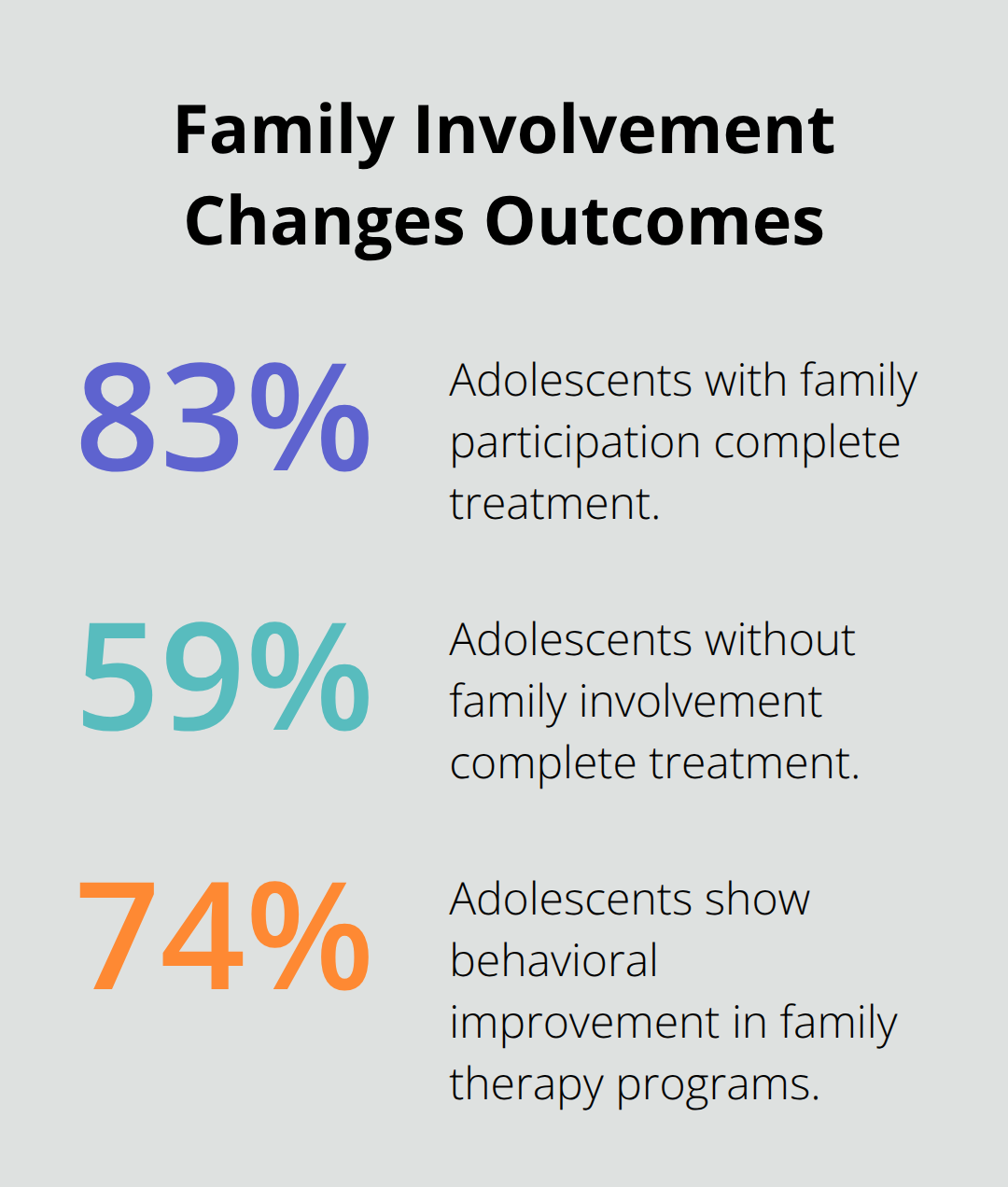
When the National Institute of Mental Health reviewed family-based approaches, they found that about 73.7 percent of adolescents show behavioral improvement in family therapy programs. Research from Welmers-van de Poll and colleagues across 20 independent samples involving roughly 2,126 families showed that stronger therapeutic alliance with the family predicts better treatment outcomes with measurable effect sizes. What matters most is that this alliance isn’t static. Measuring alliance at multiple time points-not just once-predicts outcomes more accurately because alliance changes throughout treatment. When families actively work on their relationships and communication patterns, the connection between therapist and teen strengthens, and that directly affects whether the teen applies what they learn in therapy to real life.
The Home Environment Sets the Treatment Foundation
A teen’s home is where therapy either takes root or withers. Family dynamics don’t just influence treatment-they determine its trajectory. Research shows that younger adolescents (roughly ages 10 to 13) show stronger connections between family alliance and therapy outcomes than older teens, meaning early intervention with family involvement matters considerably. Teens who voluntarily seek help show stronger alliance-outcome associations than those mandated to treatment, highlighting why family buy-in transforms reluctant participation into genuine engagement.
Within-family alliance-meaning how well the entire family unit works together-predicts outcomes just as meaningfully as individual parent-therapist or teen-therapist relationships. A fragmented family where members undermine each other sabotages treatment, while a family pulling in the same direction accelerates it. The alliance improves most when the teen reports feeling heard, not when parents or therapists feel good about progress. This distinction matters because it shifts focus from adult satisfaction to whether the teen actually experiences the family as supportive.
Building Resilience Through Shared Coping
Parents and siblings aren’t bystanders in recovery-they’re active agents. When families learn communication skills together, establish healthy boundaries, and develop shared strategies for managing emotions, teens internalize these patterns and apply them independently. Research indicates that family involvement provides a built-in support system extending far beyond therapy sessions, fundamentally changing how a teen navigates stress outside the office.
Therapists working with the whole family address household stressors, sibling dynamics, and parental anxiety that directly fuel adolescent struggles. A teen with anxiety linked to tense parent relationships experiences real relief when family therapy reduces that tension. The median treatment length with family involvement is roughly 11 weeks compared to 9 weeks without, yet the outcomes are substantially stronger and more durable. This isn’t about spending more time in therapy-it’s about transforming the ecosystem the teen lives in every single day.
What Happens When Families Actively Participate
The teen’s experience of being heard matters more than therapist or parent perceptions of progress. When the teen reports that alliance improves, treatment outcomes strengthen more reliably than when adults report improvement. This means the teen’s voice and felt sense of support drive real change. Families that maintain ongoing communication about progress, adjust strategies at home, and practice what they learn in sessions see their teens apply these skills to actual relationships and challenges.
The shift from individual treatment to family-centered care requires families to show up consistently and engage authentically in sessions. What happens next-how families translate therapy insights into daily routines and interactions-determines whether a teen builds lasting resilience or simply gets through the immediate crisis.
What Happens Inside Family Therapy Sessions
The Structure That Builds Real Change
Family therapy sessions alternate between individual work and collective meetings, and this structure prevents therapy from becoming a blame session. A typical first session starts with each family member sharing their perspective on what’s happening, while the therapist observes how they interact, interrupt, listen, or shut down. The therapist then works with the teen individually to understand their experience without parents present, establishing confidentiality and trust. Separate parent sessions follow to discuss household stressors, parenting approaches, and what drives family tension. This approach helps the therapist understand each person’s reality.
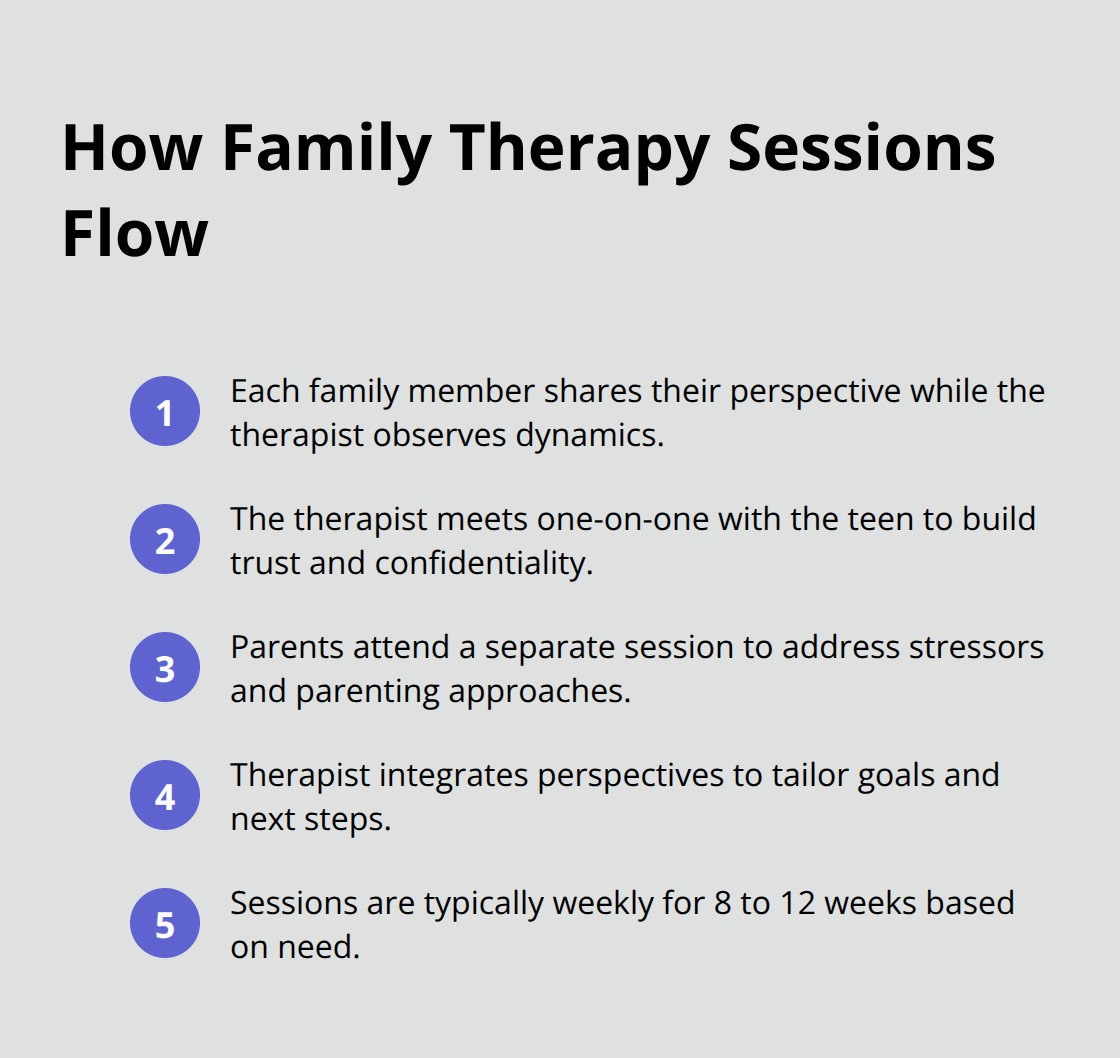
Research from Diamond and colleagues studying multidimensional family therapy found that therapists who paid close attention to the teen’s actual experience and presented themselves as the teen’s ally-not just a neutral mediator-built stronger alliances in early sessions. Teens with improved alliances showed therapists were formulating personally meaningful goals with them, not imposing adult agendas. Sessions typically occur weekly for 8 to 12 weeks, though intensity varies based on crisis level and family readiness.
Teaching Communication in Real Time
Communication skills training happens throughout sessions, not as separate lectures. The therapist coaches families in real time on how to express needs without blame, listen without defending, and stay calm during conflict. Role-playing exercises prove essential here; families practice difficult conversations in the safety of the office before attempting them at home. One proven technique involves teaching families to identify emotional triggers and develop specific responses everyone understands, so when a teen feels overwhelmed, family members know the actual action steps instead of guessing.
Naming Patterns and Shifting Focus
Addressing family patterns requires the therapist to name unhealthy dynamics directly-enmeshment, parentification, unresolved grief, untreated parental anxiety-and help the family see how these patterns fuel the teen’s struggles. A parent’s untreated depression doesn’t excuse the teen’s behavior, but it explains family dynamics and shifts treatment focus from blaming the teen to healing the system. Therapists also work with families to establish healthy boundaries around technology, create consistent routines, and designate calm-down spaces at home where the teen can regulate without judgment.
The goal isn’t perfect family functioning; it’s creating an environment where the teen feels safe enough to apply what they’re learning in therapy to actual relationships and challenges outside the office. When families translate therapy insights into daily routines and interactions, teens build the foundation they need to navigate what comes next.
What Families Actually Need to Do at Home
The gap between what happens in therapy and what happens at home determines everything. Families often leave sessions feeling motivated but then struggle to translate insights into daily routines. Start with one non-negotiable rule: establish times when phones disappear and family members talk without distractions. Research shows that families who eat together regularly report stronger connections and better teen mental health outcomes, yet the average American family eats together only a few times per week. Pick three nights and commit to them.
During these conversations, structure matters more than duration. One parent speaks about a concern without attacking, the teen responds without defending, and the other parent listens without interrupting. This takes practice. Role-play difficult topics in your head before you bring them up. If a teen has been isolating, don’t open with that accusation; instead, say what you’ve noticed and ask what’s happening. The teen’s response tells you whether they’re willing to engage or shutting down. When they shut down, stop talking and try again tomorrow. Pushing harder in that moment guarantees resistance.
Boundaries That Actually Hold
Healthy boundaries aren’t punishment disguised as structure. They’re the container that allows a teen to feel safe enough to be honest. If a teen struggles with self-harm or suicidal thoughts, the boundary is clear: you stay present, show up with empathy rather than anger, and remove access to means. This means knowing what’s in the bathroom cabinet, what’s under the bed, and what apps are on their phone. Many parents avoid this because they fear invading privacy, but a teen in crisis needs protection more than they need privacy.
Once safety stabilizes, boundaries shift. Perhaps the teen earns back phone access in their room after demonstrating they can manage it, or they text you when they leave a friend’s house not because you’re controlling but because you’ve agreed that’s how you stay connected. The boundary works when both the parent and teen understand the reason behind it. A teen told simply no without explanation resents the rule. A teen told we set this boundary because we love you and want you safe is far more likely to respect it.
Spotting Real Warning Signs
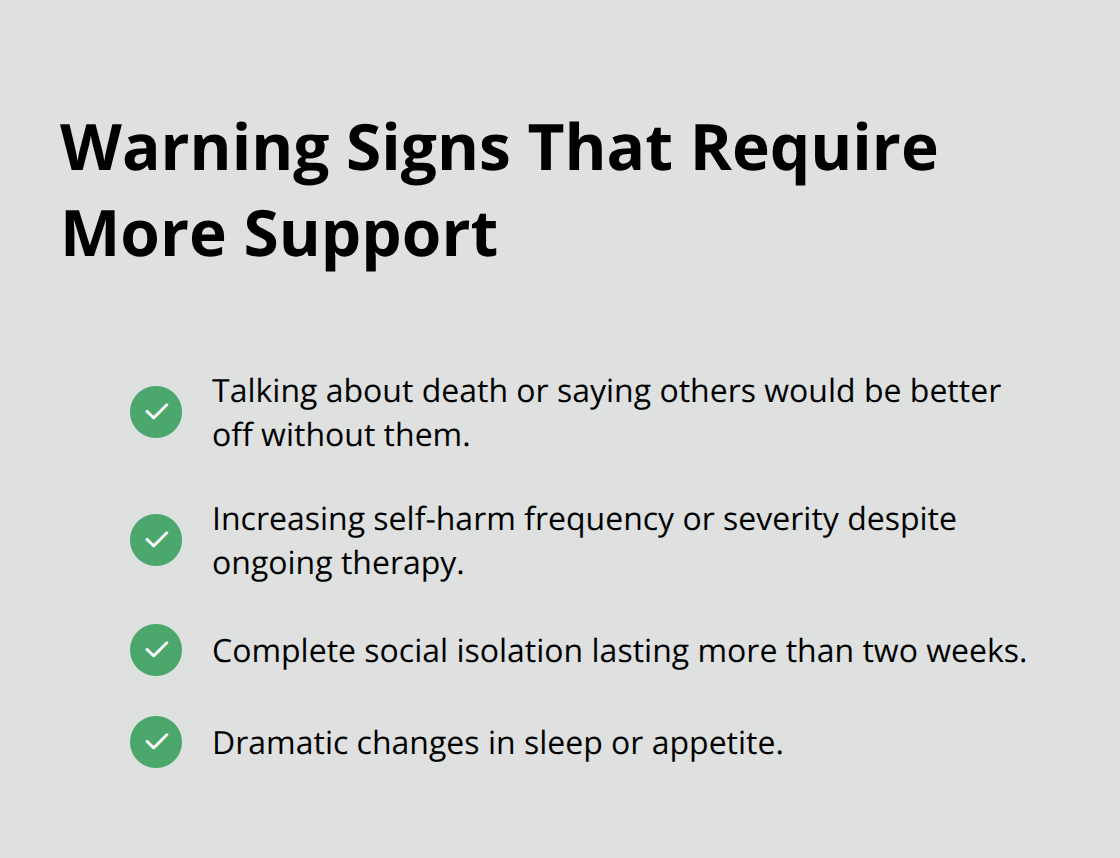
Most families wait too long to escalate care. They assume the sullenness will pass or the withdrawal is normal teen behavior. Warning signs that require additional support include a teen talking about death or expressing that others would be better off without them, increased self-harm frequency or severity despite ongoing therapy, complete social isolation lasting more than two weeks, or dramatic changes in sleep or appetite.
If a teen says they want to hurt themselves, that’s not a conversation for later; that’s a call to the crisis line or emergency room. The National Institute of Mental Health and the American Psychological Association both recommend treating any mention of self-harm or suicide as serious. Family therapy helps, but it doesn’t replace crisis intervention when needed. Know your teen’s therapist’s emergency protocol before you need it. Know which hospitals in your area have adolescent psychiatric units. Know the crisis line number. Write these down and keep them accessible, not buried in notes on your phone. When a teen is in acute distress, parents often freeze or panic; having these details written down removes one decision you have to make in a crisis moment.
Final Thoughts
Family involvement in teen therapy isn’t optional if you want lasting results. Teens with engaged families complete treatment at rates nearly 24 points higher than those without family participation, and they stay well longer because the home environment actively supports their recovery. When parents, siblings, and teens work together with a therapist to rebuild communication, establish boundaries, and develop shared coping strategies, treatment outcomes strengthen measurably.
Starting family-centered care means committing to consistent participation in sessions, practicing what you learn at home, and staying alert to warning signs that require escalation. You show up even when progress feels slow, maintain open dialogue when conflict tempts you to shut down, and trust that the work you do together in the office translates into real change in daily life. The home-clinic partnership works because it transforms therapy from something that happens once a week into something that happens every single day through the relationships and routines you build at home.
If your teen is struggling with mental health challenges and you’re ready to involve your whole family in their recovery, The Teen Center delivers specialized, evidence-based care that combines individual therapy, family involvement, and crisis support designed specifically for adolescents. We understand how powerful family involvement in teen therapy truly is, and we’re here to help your family take that first step toward lasting change.