
Anxiety affects roughly 1 in 5 teens, and many struggle to find effective ways to manage it. Cognitive behavioral therapy for teens has become one of the most evidence-backed approaches to reduce anxious thoughts and build real coping skills.
At The Teen Center, we’ve seen firsthand how CBT techniques can transform the way young people handle stress and worry. This guide walks you through practical strategies that work.
How CBT Actually Works for Teen Anxiety
The Thought-Emotion-Behavior Cycle
CBT operates on a straightforward principle: your thoughts shape your emotions, which then drive your behavior. When a teen thinks “I’m going to fail this test,” that thought triggers anxiety, which leads to avoidance behaviors like skipping class or not studying. CBT interrupts this cycle by teaching teens to identify distorted thinking patterns and replace them with more realistic ones.
The structured, goal-oriented format means each session targets specific anxious thoughts or avoidance behaviors, with homework assignments reinforcing progress. Teens respond well to CBT because it feels less abstract than traditional talk therapy; they work through concrete exercises like thought records, where they document a stressful situation, write down their automatic anxious thought, identify the emotions that follow, and then develop a more balanced reframing. This hands-on approach builds self-awareness rapidly.
Evidence-Based Results for Teen Anxiety
Research from the Cochrane review by James et al. shows that teens with a primary anxiety disorder treated with CBT achieved a 49.4% remission rate at the end of treatment, compared to just 17.8% for those on a waitlist. This gap exists because CBT isn’t passive-it requires teens to actively practice new skills both during and between sessions.
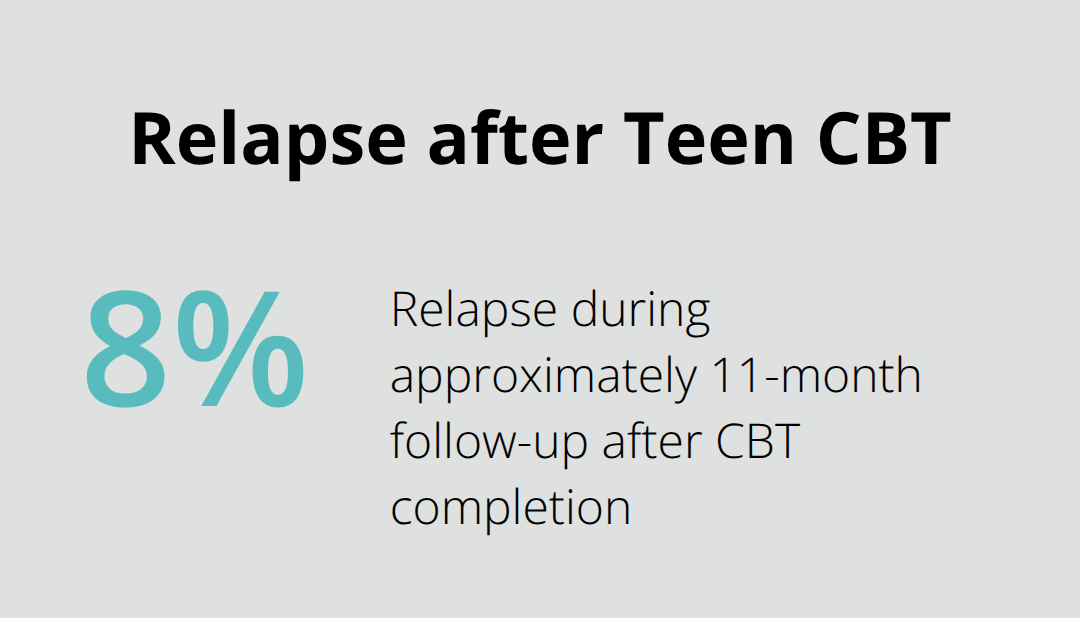
A study published in the Journal of Clinical Child & Adolescent Psychology found that about two-thirds of teens with anxiety show favorable responses to CBT, with moderate to large effects observed across multiple studies. About 8% of teens experience relapse during follow-up periods averaging 11 months after CBT completion, according to research by Levy et al. in the Journal of Child Psychology and Psychiatry, meaning the skills stick.
How the Brain Responds to CBT
The brain science supports why CBT works during adolescence specifically. Research on neural predictors of CBT response points to how threat-processing circuits in the brain-particularly in the prefrontal cortex and amygdala-shift when teens practice these techniques consistently. Greater activation in the dorsolateral and ventrolateral prefrontal cortex during threat exposure correlates with stronger treatment gains.
Repeated exposure to feared situations, combined with cognitive restructuring, literally rewires how the teen’s brain responds to anxiety triggers. This neurological shift explains why the benefits of CBT persist long after treatment ends.
Building Independent Coping Skills
Teens also benefit from CBT’s emphasis on building independent coping skills that extend beyond the therapist’s office. Instead of relying on an adult to manage their anxiety, they learn to recognize their own thought patterns, challenge catastrophic predictions, and apply coping strategies in real-time. This independence is essential for adolescent development and builds genuine confidence rather than temporary reassurance.
The practical application of these skills happens outside sessions, where teens face real-world situations and test what they’ve learned. Understanding how CBT reshapes both thought patterns and brain function sets the stage for the specific techniques you can implement right now.
What Teens Can Do When Anxiety Strikes
Interrupt the Anxious Thought Immediately
The moment anxiety hits, most teens freeze or spiral deeper into worried thoughts. The truth is that waiting for anxiety to pass on its own rarely works, and avoidance only strengthens the anxious response. Start with the exact thought triggering the anxiety. When a teen thinks “I’ll embarrass myself in front of the class,” that specific thought becomes the target. Have them write it down immediately, not hours later when the memory fades. This captures the raw anxious thought before it distorts further.
Challenge Thoughts With Evidence
Once the thought is written, the teen asks two critical questions: What evidence supports this thought? What evidence contradicts it? A thought record forces this comparison directly. If the teen has given presentations before without embarrassment, that’s direct evidence against the catastrophic prediction. The reframed thought might become “I’ve presented before and handled it fine, so I can do this too.” This isn’t positive thinking nonsense; it’s replacing distorted thoughts with factual ones. Research shows that cognitive restructuring helps teens actively practice this approach in sessions.
Take Action Through Behavioral Activation
The second piece is behavioral activation, which means doing the thing that causes anxiety rather than avoiding it. Avoidance feels safe in the moment but teaches the brain that the situation is genuinely dangerous, which locks anxiety in place. A teen afraid of social situations who skips lunch with peers reinforces that belief every single time. Instead, start small. Sit with one new person at lunch for five minutes. Attend the club meeting for ten minutes before leaving if needed. Each exposure, even partial, sends the brain a corrective message: this situation isn’t actually threatening.
Build a Personal Coping Skills Toolbox
The final tool is a personal coping skills toolbox, where teens compile and practice specific strategies before they’re in crisis. This might include box breathing (four counts in, four counts hold, four counts out), a ten-minute walk, calling a trusted person, or listening to a specific playlist. The key is practicing these when calm so they’re automatic when anxiety peaks. Teens who wait until panic hits to figure out what helps waste critical moments. The toolkit takes weeks to build, not days, but it transforms anxiety from something that controls them into something they can manage independently.
Once teens master these three tools-identifying thoughts, challenging them with evidence, and taking action-they’re ready to apply them across different situations. The next chapter explores how parents and therapists can reinforce these skills at home and in therapy sessions.
Supporting Teen CBT at Home and in Therapy
Establish Structured Accountability
Parents and therapists must do far more than assign CBT homework and hope teens practice it. The environment where practice happens determines whether teens develop lasting anxiety management skills or abandon the techniques when pressure increases. Parents should establish a weekly check-in time, ideally 15 minutes on the same day each week, where they ask specific questions about which thought records their teen completed, what evidence the teen found against anxious thoughts, and which coping strategies worked that week. This isn’t a casual conversation; it’s structured accountability that signals to the teen that these skills matter.
Therapists need to calibrate homework difficulty carefully. Research shows that when pretreatment anxiety severity is higher, teens show somewhat poorer outcomes, which means therapists must start with easier exposures and build gradually rather than overwhelming teens with aggressive behavioral activation too quickly. A teen terrified of social situations shouldn’t face large group settings immediately; instead, they might text one peer, then eat lunch near others, then join a small study group over weeks. Parents sometimes undermine this progression by pushing too hard, so therapists should communicate the exposure timeline directly to parents and explain that smaller steps actually lead to faster long-term progress.
Model Balanced Thinking
Therapists should ask parents whether they model balanced thinking themselves or whether they catastrophize around their teen. Parent anxiety and stress can undermine their teen’s treatment effectiveness, meaning anxious or stressed parents actually make their teen’s treatment less effective. Parents who say things like “I’m so worried you’ll fail that test” or “I get panic attacks too, so I understand your anxiety” inadvertently teach their teen that anxiety is inevitable and unmanageable.
Instead, parents should demonstrate the exact CBT skills their teen is learning. When facing a stressful situation, a parent might think aloud: “I’m worried about this meeting, but I’ve handled similar situations before, so I can manage this.” That models cognitive restructuring in real time. This approach shows teens that adults also experience anxiety but possess tools to work through it.
Track Progress With Concrete Data
Monitoring progress requires concrete data, not impressions. Therapists and parents should track specific metrics: How many days this week did the teen practice their coping toolbox? How many exposures did they attempt? Did they attend school all five days or did anxiety cause avoidance? Mood tracking apps or simple journals work well because they create a visible record that both teen and parent can review.
When progress stalls, that data points directly to which skills need more practice or which exposures need adjustment, rather than conversations devolving into blame or frustration. A teen who completes only one thought record per week but attempts three exposures shows strength in behavioral activation but needs support with cognitive work. That specific insight allows therapists and parents to redirect effort where it matters most.
Final Thoughts
CBT for teens works because it hands young people concrete tools to interrupt anxiety cycles right now, not someday. The research is clear: nearly half of teens with primary anxiety disorders achieve remission through cognitive behavioral therapy for teens, and about two-thirds respond favorably to treatment. More importantly, roughly 8% experience relapse after treatment ends, meaning the skills teens learn actually stick around.
The three-part approach-identifying anxious thoughts, challenging them with evidence, and taking action through exposure-creates a foundation that teens apply independently across situations. Parents and therapists amplify these results by establishing structured accountability, modeling balanced thinking themselves, and tracking concrete progress rather than relying on feelings. When a parent demonstrates how they work through their own anxiety using the same CBT techniques their teen is learning, the message becomes clear: anxiety is manageable, and these tools actually work.
Teens who master these skills during their adolescent years develop resilience that carries into adulthood. They learn to recognize distorted thinking patterns before they spiral, they practice facing difficult situations instead of avoiding them, and they build confidence through repeated success. If your teen is struggling with anxiety and you’re ready to move beyond general advice, The Teen Center delivers specialized, evidence-based mental health care for adolescents ages 12–17, including individual therapy, family involvement, and crisis support both in person and through telehealth.