Anxiety crises hit teens hard and fast. When panic strikes, every second counts, and knowing where to turn makes all the difference.
At The Teen Center, we’ve seen firsthand how crisis support pathways for teens can transform a moment of panic into a path toward stability. This guide walks you through immediate help options and the longer-term support that prevents future crises.
Understanding Teen Anxiety Crises
What Sets Off an Anxiety Crisis in Teens
Anxiety crises don’t happen in a vacuum. Specific stressors trigger them, either through gradual buildup or sudden impact. Chronic stress from school pressure, social conflicts, or family instability creates a foundation where panic takes root easily. Environmental shocks matter too: a relationship breakup, job loss in the family, illness, or academic failure can spark an acute episode. During the pandemic, emergency room visits for anxiety-related disorders increased among teens ages 12–17 according to CDC data, showing how external pressures translate into crisis moments. The pandemic also created a surge in eating disorders and tic-like movements among teenage girls, with some linked to social media exposure, illustrating how modern stressors operate differently than they did a decade ago. These triggers are real and measurable, not imagined weakness. A teen experiencing a crisis isn’t overreacting; their nervous system is genuinely flooded.
Spotting the Physical and Behavioral Red Flags
An anxiety crisis shows up in unmistakable ways. Physically, teens report chest tightness, shortness of breath, dizziness, rapid heartbeat, sweating, and trembling. These symptoms feel terrifying because they mimic a heart attack, which intensifies the panic. Behaviorally, watch for sudden withdrawal from activities they normally enjoy, neglecting self-care, extreme mood swings, expressions of hopelessness or guilt, and talk of self-harm. According to CDC data, about 1 in 5 US children ages 3–17 have a mental, emotional, developmental, or behavioral disorder, meaning these signs are far more common than many parents realize. The aftermath of a crisis matters too: sleep disturbances and intrusive replay of the episode often persist, leaving teens vulnerable to another panic attack. Multiple signs together-anxiety plus depression plus hopelessness-signal that professional intervention is needed now, not later.
Why Speed Saves Lives
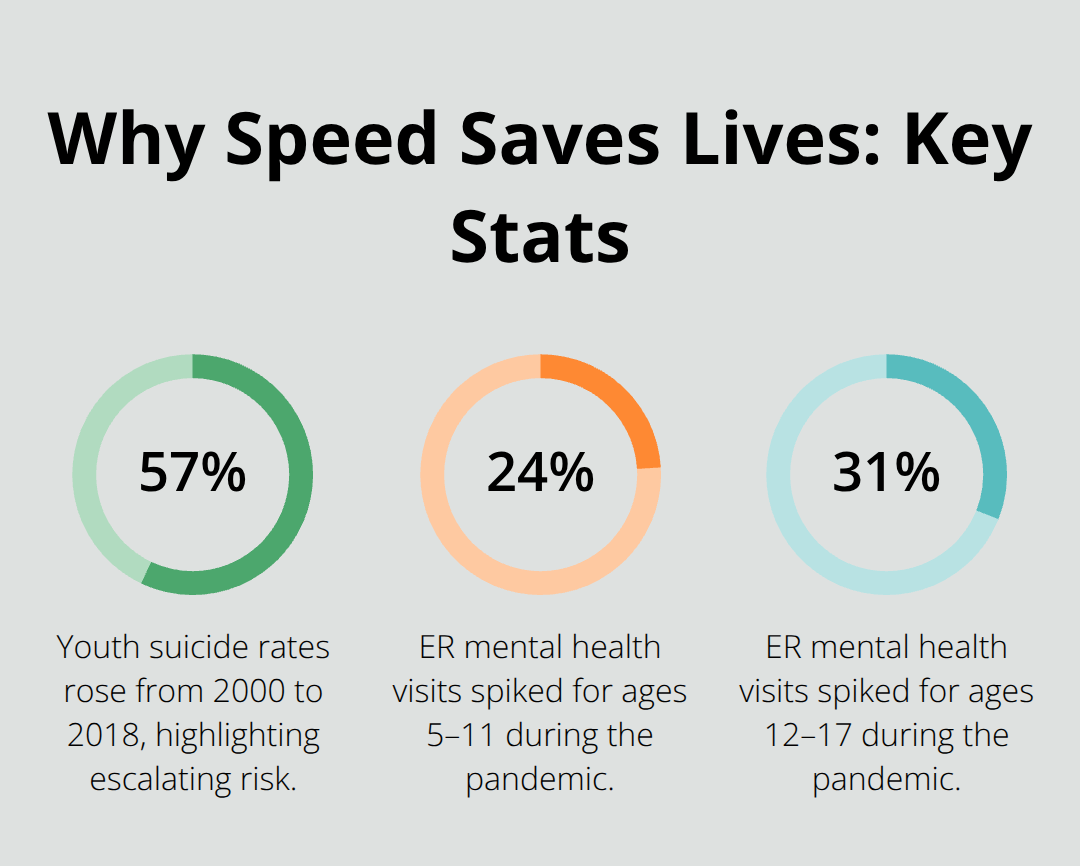
Fast response directly reduces harm. Research shows that youth who receive a follow-up mental health visit within 7 days after a psychiatric crisis have significantly lower suicide risk compared to those with delayed care. Youth suicide rates rose roughly 57% from 2000 to 2018, and half of all mental illnesses begin by age 14, according to the CDC. About one-third of Americans live in mental health professional shortage areas, which is why immediate crisis pathways matter more now than ever.
Mobile crisis teams and crisis stabilization units exist specifically to bridge that gap, providing on-site de-escalation and urgent support that prevents emergency room overload and unnecessary hospitalizations. Panic disorders affect roughly 2–3% of Americans annually, and they don’t resolve without intervention. Hours matter when a teen is in acute distress, which is why immediate crisis support options exist and why knowing how to access them can change everything.
How to Access Crisis Help Right Now
Text and Phone Lines: The Fastest Route to Support
When a teen faces acute distress, text and phone lines offer the fastest route to immediate support without scheduling delays or travel friction. Crisis Text Line operates 24/7-a teen texts 741741 to connect with a live counselor, which works especially well for teens who freeze on phone calls or need support at 3 AM. The National Mental Health Hotline at 866-903-3787 connects directly to professionals who guide teens through panic symptoms and assess whether emergency care is needed. SAMHSA’s National Helpline at 1-800-662-4357 provides confidential referrals to local treatment services, which matters because one-third of Americans live in mental health professional shortage areas.
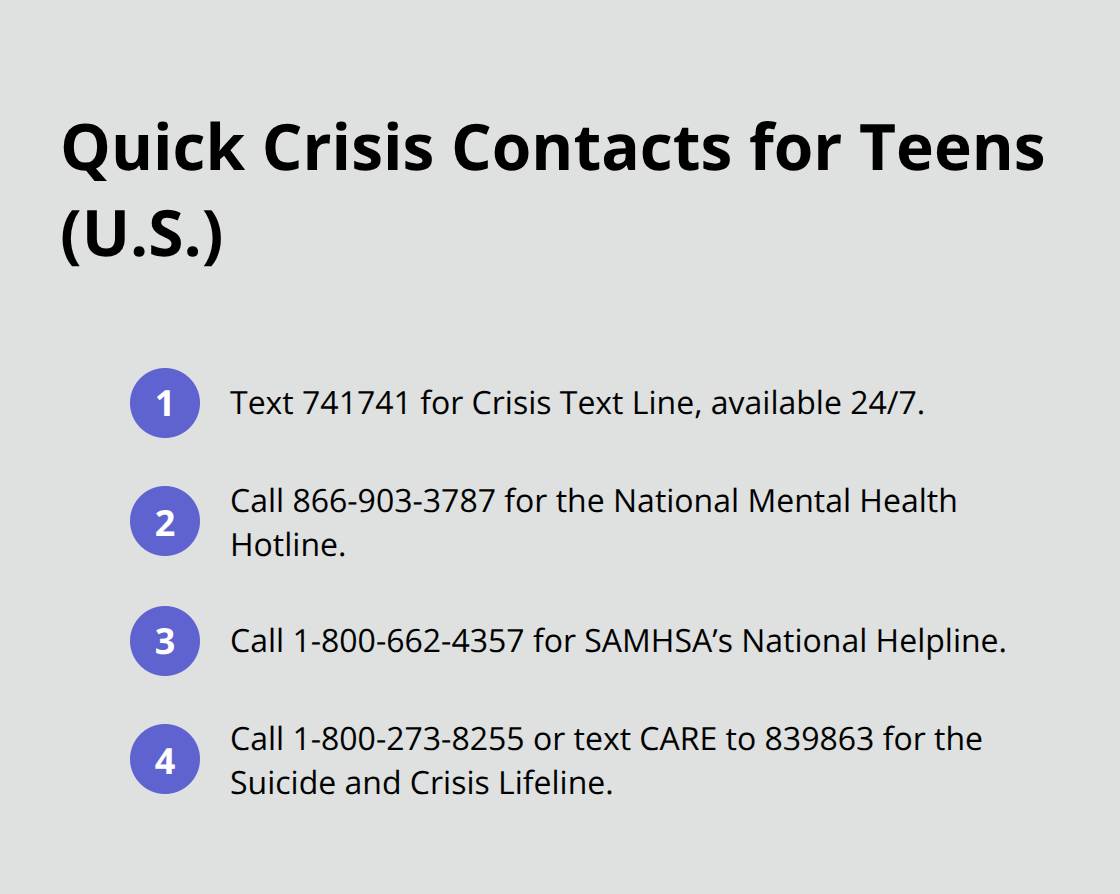
The Suicide and Crisis Lifeline at 1-800-273-8255 also accepts texts by sending CARE to 839863, removing the voice-call barrier for anxious teens. Counselors teach immediate coping techniques like controlled breathing and grounding exercises during the call, giving teens concrete tools to stabilize before any other intervention. Texas data from 2021–2022 show that mobile crisis teams handled 12,771 calls, demonstrating that these pathways prevent unnecessary emergency room visits and hospitalizations. Rural youth accessed crisis services 150% more per capita than urban youth from 2017–2021, revealing that phone and text lines serve as critical equalizers for teens in underserved areas.
Emergency Departments: When Life-Threatening Crises Demand Immediate Care
Emergency departments remain essential for life-threatening crises, though they’re not ideal for ongoing treatment. When a teen expresses suicidal intent, shows signs of severe self-harm, or experiences symptoms that feel medically catastrophic, 911 and the ER are appropriate responses. However, ER visits for youth mental health spiked 24% for ages 5–11 and 31% for ages 12–17 during the pandemic according to CDC data, overwhelming acute-care systems designed for physical emergencies. This surge underscores why alternative pathways matter for teens in moderate distress who need professional evaluation but aren’t in immediate danger.
Telehealth Crisis Appointments: Professional Care Without the ER
Telehealth crisis appointments fill the gap between crisis lines and emergency rooms for teens who need professional evaluation but aren’t in immediate danger. Many providers now offer same-day or next-day virtual appointments, eliminating wait times that stretch days in traditional office settings. Insurance coverage varies, but most major plans including Aetna, Blue Cross Blue Shield, Cigna, and UnitedHealthcare cover crisis telehealth appointments, making them financially accessible for most families. The advantage of telehealth during a crisis is that teens remain in a familiar environment where they feel safer, and parents or guardians can be present without the intimidation factor of an emergency room. Specialized adolescent providers combine rapid access with evidence-based care tailored to how teens actually experience anxiety and panic.
Building Your Crisis Action Plan
Knowing these options in advance transforms how a family responds when panic strikes. A teen and their parent should identify which resource fits their situation-text lines for immediate grounding, telehealth for professional assessment, emergency services for life-threatening symptoms. Having phone numbers saved and discussing the plan during calm moments removes decision-making friction when anxiety floods the brain. This preparation matters because crisis support works best when teens know exactly where to turn before they’re in acute distress.
Therapy and Recovery After the Crisis Passes
The Critical First Week Sets the Trajectory
The first week after a crisis determines whether a teen stabilizes or spirals. Research published in JAMA Network Open shows that teens who receive a follow-up mental health visit within seven days of discharge from a psychiatric crisis have significantly lower suicide risk than those with delayed care. This isn’t about waiting for a convenient appointment slot; it’s about immediate continuity. A therapist trained in evidence-based approaches like Cognitive Behavioral Therapy or Dialectical Behavior Therapy helps a teen understand what triggered the panic, identify early warning signs before the next crisis, and build concrete coping skills. Individual therapy works best when it addresses the specific cause, not just generic anxiety management. If a teen’s crisis stemmed from social conflict, therapy focuses there. If it was academic pressure, that becomes the centerpiece.
Tailored Treatment Plans That Actually Work
The treatment plan should map out exactly how many sessions per week the teen needs, what specific symptoms the therapist is targeting, and when the plan gets reviewed. Specialized adolescent providers combine rapid access with individualized treatment that addresses how teens actually experience anxiety rather than treating all panic the same way. Many teens resist therapy after a crisis because they feel embarrassed or think one crisis means they’re broken forever. That’s wrong. The crisis was a sign that their current coping tools weren’t enough for the stress they faced. Therapy teaches new tools. It takes work, but it works.
Family Involvement Prevents Relapse
Family involvement during recovery isn’t optional; it’s the foundation that prevents relapse. Parents and guardians need to understand what anxiety looks like in their specific teen, what their early warning signs are, and how to respond without dismissing or catastrophizing. If a parent says things like “you’re fine, just calm down,” the teen learns to hide symptoms next time rather than ask for help. Instead, families benefit from structured sessions where a therapist coaches everyone on how to talk about anxiety, how to validate without enabling avoidance, and how to coordinate responses when stress builds.
School Coordination Bridges Treatment and Daily Life
School coordination matters equally because academics were often part of the trigger. A teen returning to school after a crisis needs communication between parents, the therapist, and school counselors about what academic accommodations might help during recovery. Some teens need temporary reduced course loads, extended test time, or permission to step out of class when anxiety spikes. Federal investments have expanded school-based mental health services to support mental health care and grow the mental health workforce. Schools are now recognized as primary access points for youth mental health according to the American Academy of Pediatrics. This means coordinating your teen’s treatment plan with their school isn’t extra work; it’s using a resource that’s increasingly available.
Building a System That Catches Anxiety Early
The goal after crisis isn’t just survival; it’s building a system where the teen, family, therapist, and school all communicate so anxiety gets caught early before it becomes a crisis again. When these four parties stay connected (through regular check-ins and shared updates), warning signs surface before they escalate. A teen who starts withdrawing from friends or skipping homework alerts the school counselor, who contacts the therapist, who adjusts the treatment plan.
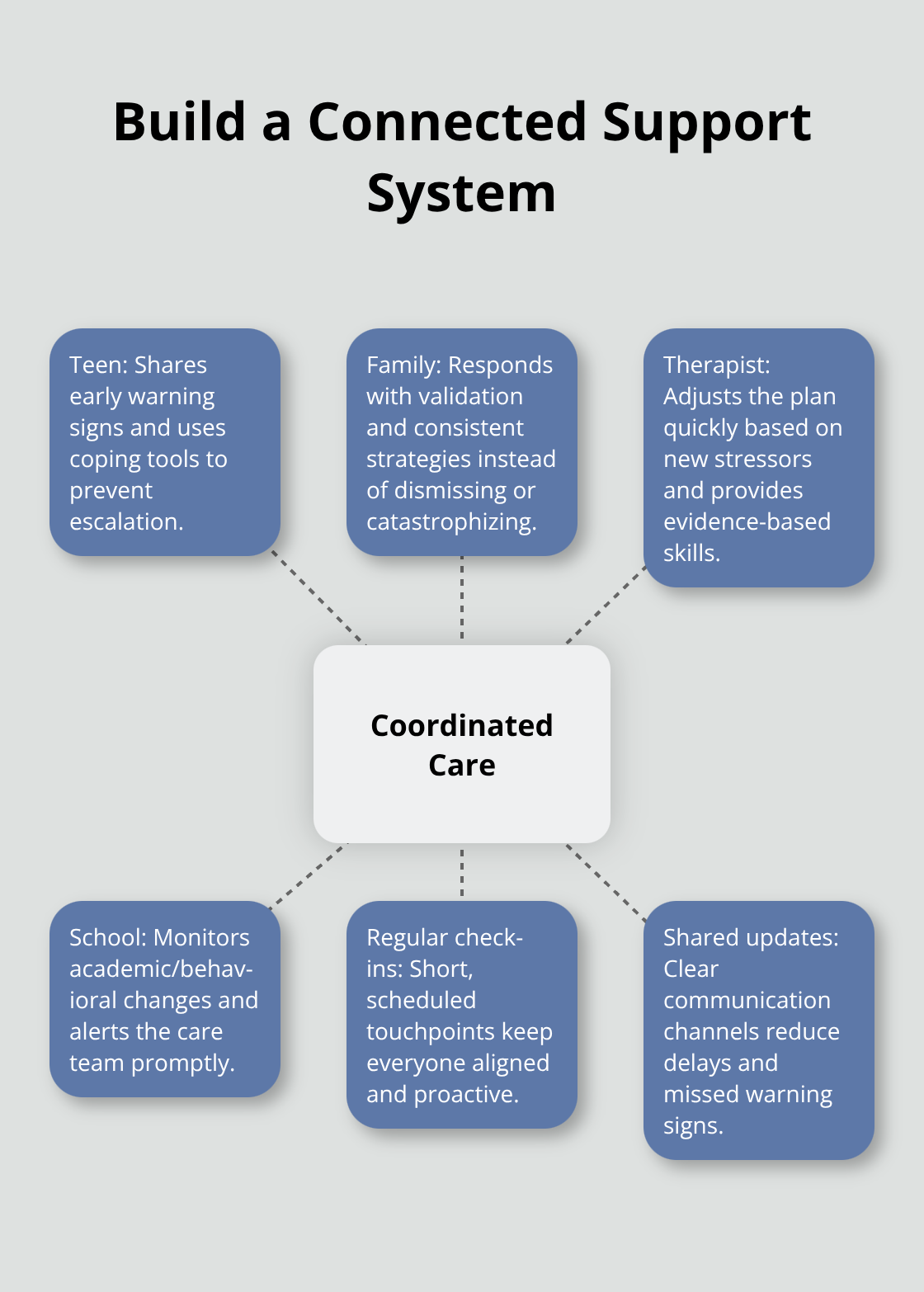
This coordination prevents the slow buildup that leads to another panic attack. The system works because everyone knows their role and talks to each other.
Final Thoughts
Crisis support pathways for teens work because they connect immediate help with lasting recovery. A teen in acute distress needs fast access to a crisis line or telehealth appointment, but that moment of stabilization only matters if it leads somewhere. The real power emerges when crisis support becomes part of a larger system where therapy, family involvement, and school coordination all reinforce each other.
Teens who receive follow-up care within days of a crisis have dramatically lower suicide risk, and that follow-up isn’t bureaucratic overhead-it’s the difference between a teen who learns to manage anxiety and one who cycles through repeated crises. When a therapist, family, and school stay connected, warning signs surface early, and a teen withdrawing from friends or neglecting schoolwork gets caught before panic escalates. This coordination prevents the slow buildup that leads to another emergency.
If your teen has experienced a crisis, reach out to The Teen Center to build a recovery plan that works. Crisis support pathways for teens function best when they’re part of comprehensive care designed specifically for how adolescents heal.