
Your teen’s therapist keeps detailed notes about every session. These records matter-they track progress, meet legal requirements, and help your teen get consistent care.
At The Teen Center, we know parents often wonder what’s in those notes and what they’re allowed to see. Understanding therapy documentation helps you support your teen’s mental health journey without crossing privacy boundaries.
Why Therapists Keep Detailed Records
Treatment Notes Track Progress and Goals
Therapists document every session because notes serve three essential functions that directly affect your teen’s care quality. First, treatment notes track what your teen is working on and whether they’re making progress toward specific goals. A progress note summarizes the session content, identifies patterns, and shows movement toward those goals stated in the treatment plan. Without these records, your teen’s therapist would have no way to measure whether therapy is actually working or to adjust the approach when something isn’t landing.
Legal and Ethical Requirements Mandate Documentation
Second, detailed documentation is a legal and ethical requirement. Mental health providers must follow state regulations and professional ethics standards that mandate record-keeping. In Arizona, for example, therapists are required to document treatment plans and progress notes as part of standard care. These records protect both your teen and the therapist by creating a clear account of what happened during treatment, what decisions were made, and why.
Continuity of Care Depends on Detailed Records
Third, notes support continuity of care. If your teen ever needs to see a different therapist or if their current therapist needs to step in during a crisis, those detailed records mean the new provider can understand your teen’s history, what’s been tried, and what’s working. This prevents your teen from having to restart their story from scratch.
What Actually Gets Documented
The specifics of what gets documented matter. Treatment notes include the teen’s reported concerns, observations about their emotional state and behavior, progress toward therapy goals, and the therapist’s clinical impressions. They do not include every word your teen said or every tangent the conversation took. Instead, notes capture the meaningful content that relates to treatment goals and safety. If your teen mentions they’re struggling with anxiety around school, that gets documented. If they mention their favorite music, it typically doesn’t unless it’s directly relevant to a therapy goal.
This distinction is important because it means your teen can feel safe speaking openly without worrying that everything will be transcribed. Informed consent forms at the start of therapy explain these documentation practices and outline what information might be shared with parents if safety concerns arise. The core purpose of these detailed, thoughtful records is straightforward: they make therapy more effective, protect everyone involved, and ensure your teen receives consistent, informed care across every session. Understanding what therapists actually document sets the stage for knowing what you can access and how to interpret what you see.
What Parents Can Actually Access
Understanding Your Legal Rights to Records
HIPAA Privacy Rule allows parents the right to see their children’s medical records. In Arizona, caregivers must consent to treatment for minors under 18, which gives parents the right to access official treatment documents. However, access does not mean you receive everything. Parents typically obtain the treatment plan, which outlines your teen’s therapy goals and the general approach your therapist will use. You also receive progress notes that summarize sessions and show movement toward those goals. What you do not automatically receive is a verbatim transcript of every word your teen said or detailed clinical impressions that extend beyond what’s necessary for treatment.
What Treatment Documents Actually Contain
The difference between what you can access and what gets documented matters significantly. A progress note might state that your teen is working on managing social anxiety through cognitive techniques and showed improvement this week. It will not transcribe your teen’s entire conversation or include every thought the therapist explored. State law determines who qualifies as a personal representative with access rights, and HIPAA defers to those state-specific rules rather than imposing one national standard. This means your access rights in Arizona differ from those in California or New York. Before your teen starts therapy, the informed consent document should clearly explain what you can access, when you will receive updates, and what information triggers a call to you about safety concerns. If that conversation does not happen upfront, ask for it. Clarity now prevents confusion and frustration later.
How Therapists Share Information With Parents
Your therapist will likely offer you learning-focused summaries when you ask about session content, rather than clinical details. This approach protects your teen’s privacy while keeping you informed about progress and practical strategies you can reinforce at home. If your teen faces risk due to suicidal thoughts, substance abuse, or abuse, your therapist will inform you about the risk itself, not necessarily every detail from sessions. That’s an ethical requirement, not a limitation. Some therapists invite your teen to discuss their therapy work with you directly, while others periodically invite you into sessions to recap progress together. Both approaches work well when executed intentionally.
Alignment Across the Treatment Team
The key is alignment: you, your teen, and the therapist should all understand the boundaries before therapy starts and revisit them if circumstances change. This shared understanding creates a foundation of trust that actually strengthens your teen’s willingness to engage in treatment. When everyone knows what to expect regarding privacy and communication, your teen can focus on their healing rather than worrying about what you might learn. The next section walks you through how to actually read and interpret the documents you do receive, so you can make sense of clinical language and recognize what progress really looks like.
Reading Between the Lines in Therapy Notes
Understanding Clinical Language in Progress Notes
Therapy notes use clinical language that can feel unfamiliar if you haven’t studied psychology. When you see terms like cognitive distortion, affect regulation, or psychoeducation, those words describe specific therapeutic work your teen completes. Cognitive distortion means your teen learns to recognize when their thinking patterns aren’t accurate-like assuming everyone judges them when that’s not true. Affect regulation means they build skills to manage their emotions instead of being overwhelmed by them. Psychoeducation means the therapist teaches your teen about their condition so they understand what’s happening and why certain strategies help.
The treatment plan lists these goals explicitly, so when you read a progress note that says your teen works on cognitive restructuring around social situations, you can flip back to the goals section and see that this aligns with what you already know they’re targeting.
What Behavioral Observations Tell You
Progress notes also include clinical observations about your teen’s emotional state and behavior during sessions. You might see language like engaged, withdrawn, tearful, or defensive. These observations matter because they show the therapist’s real-time assessment of how your teen presented that week. If notes consistently show your teen as withdrawn and your teen claims they’re doing great, that’s information worth exploring further. If notes show increasing engagement and eye contact over several sessions, that’s a concrete sign of progress.
Recognizing Real Progress in the Data
The real value in reading these notes is spotting patterns and understanding what improvement actually looks like. Research on adolescent therapy outcomes shows that progress doesn’t follow a straight line. Teens typically show improvement in small increments across multiple weeks, with occasional setbacks.
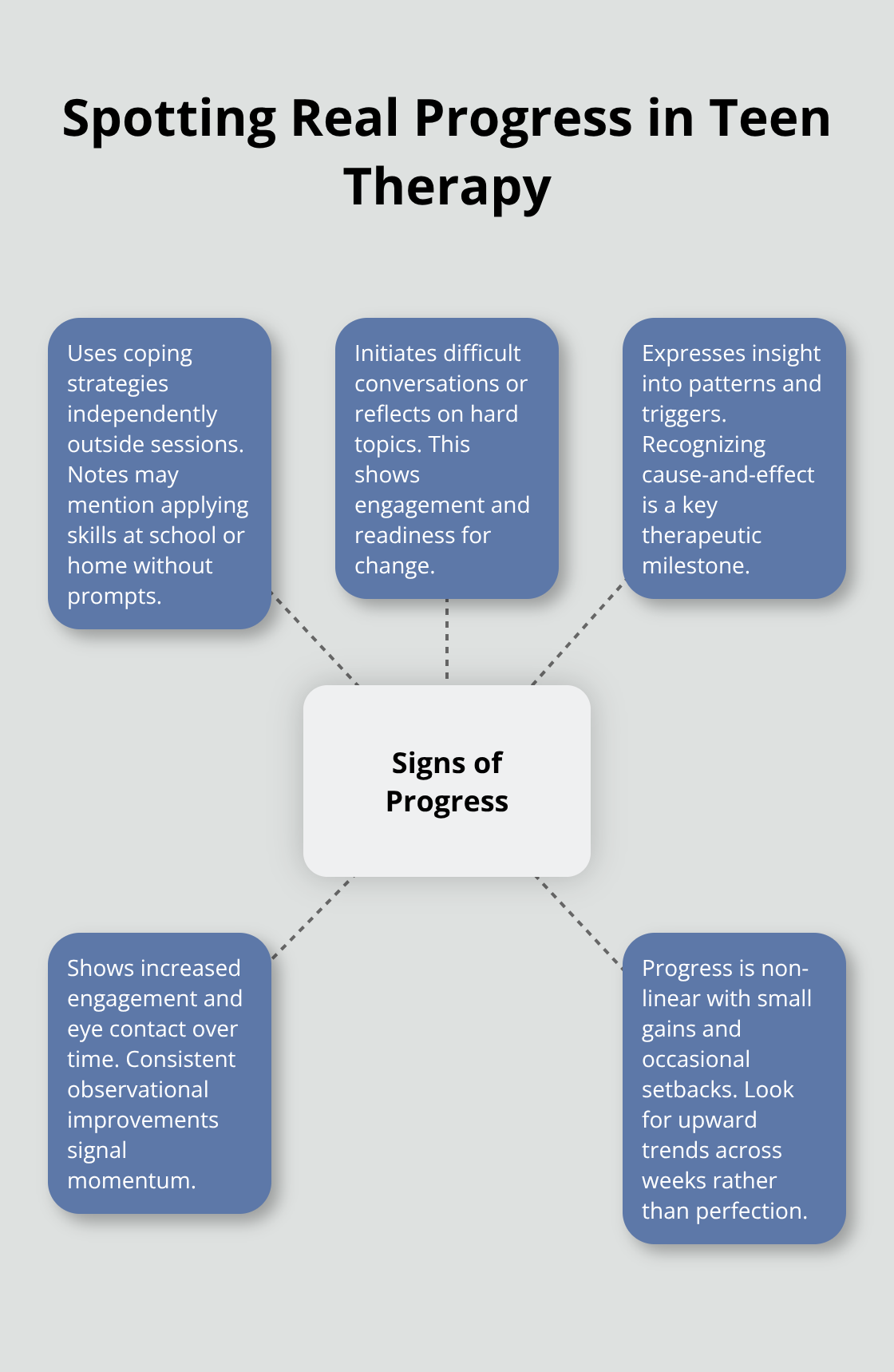
If your teen’s notes show they struggled with anxiety in week three but managed it better in week five, that’s meaningful progress even though it wasn’t consistent.
Look for notes that mention your teen using coping strategies independently, initiating conversations about difficult topics, or expressing insight into their patterns. These indicators mean your teen genuinely builds skills, not just talks about problems.
Reinforcing Therapy Work at Home
At home, you can reinforce this work by noticing when your teen uses those strategies and naming what you see. If your teen took a break to regulate their emotions before responding to a conflict, that’s a coping skill in action. Point it out without making it awkward. You might say something straightforward like “I noticed you took a few minutes before responding-that’s exactly what you’ve been working on in therapy.” This simple acknowledgment strengthens the connection between therapy work and daily life.
Ask your therapist specifically what strategies your teen learns so you know what to look for and reinforce. Some therapists offer a brief summary of session themes and homework assignments, which gives you concrete things to support. If your teen works on assertiveness, you might notice opportunities at home to encourage them to express their needs. If they build distress tolerance, you can observe and affirm when they handle frustration without shutting down. The goal isn’t to quiz your teen or monitor their progress obsessively. The goal is to create a consistent environment where the skills they learn in therapy actually get practiced and reinforced in real life, which is where lasting change actually happens.
Final Thoughts
Trust between parents, teens, and therapists develops when everyone agrees upfront about what gets shared, why, and when. Your teen needs to know their sessions remain a safe space where they can speak openly. You need clarity about your access rights and what information prompts a conversation about safety. Your therapist needs both of you aligned so they can focus on treatment rather than managing conflicting expectations.
If you start this journey with your teen, have the confidentiality conversation before the first session. Ask your therapist to explain what you’ll receive, how often, and what circumstances would prompt them to contact you. If your teen already receives therapy, revisit these boundaries if anything feels unclear. When you finish reading teen therapy notes and struggle to understand what they mean, ask your therapist to walk you through them-that’s not overstepping, that’s being an informed parent.
We at The Teen Center work with families navigating this situation every day. We deliver evidence-based mental health care for adolescents ages 12 through 17, offering individual and family therapy, medication management, and crisis support both in person and via telehealth. Your teen’s mental health matters, and so does your role in supporting it.