
When a teen struggles with anxiety, parents often feel helpless. They want to support their child but don’t know where to start or how to help effectively.
At The Teen Center, we’ve seen firsthand that teen anxiety family involvement transforms treatment outcomes. Parents aren’t bystanders-they’re essential partners who can directly reduce their teen’s anxiety symptoms and build lasting recovery skills.
Does Parental Involvement Actually Change Teen Anxiety Outcomes
Research proves parents shift treatment results
A meta-analysis of 20 randomized trials involving 2,270 adolescents found that adding a parental component to therapy produces measurable improvements over adolescent-only treatment. The effect size was small but significant, meaning parents genuinely alter the trajectory of recovery. For externalizing problems like aggression or defiance, parental involvement showed stronger gains than for internalizing issues like worry. What matters most is frequency-based change-how often problematic behaviors occur-where parental involvement delivered a meaningful reduction. This isn’t theoretical. Parents who actively participate in treatment help their teens practice new skills at home, interrupt anxiety-driven avoidance patterns, and model calmer responses to stress.
Family involvement accelerates real-world recovery
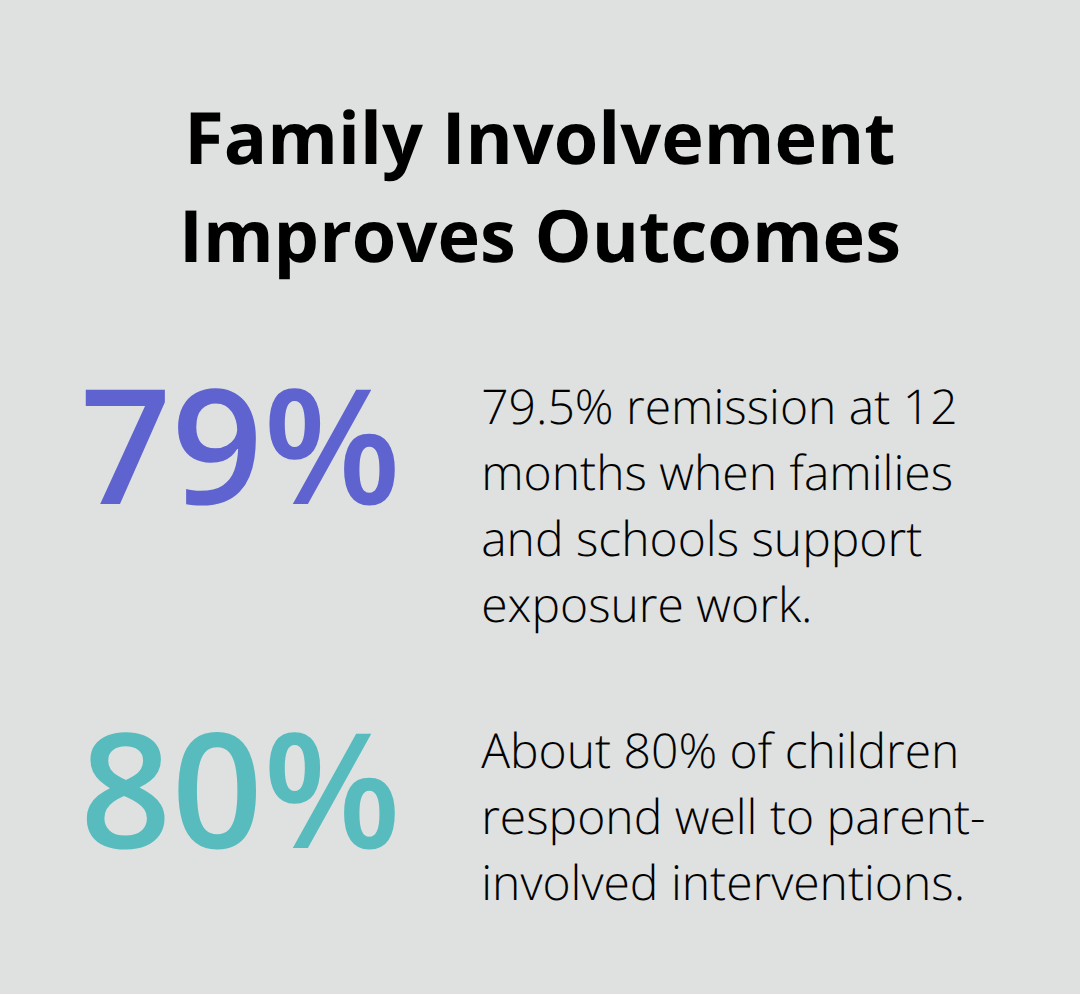
A study of group cognitive behavioral therapy for adolescents with anxiety disorders and OCD found a 79.5% remission rate at 12-month follow-up when families and schools actively supported exposure work. Without that family layer, teens often revert to old patterns between sessions because anxiety thrives in isolation and avoidance. Family dynamics directly shape whether therapy sticks or fades.
Parental expressed emotion-how critical, hostile, or emotionally enmeshed parents become around the teen’s anxiety-predicts outcomes. Reductions from high to low expressed emotion correlate with better anxiety results.
Breaking the Protection Trap
Parents who accommodate anxiety by allowing avoidance (skipping school to avoid social situations, sleeping in the parent’s room to manage nightmares) inadvertently reinforce it. About 80% of children respond well to parent-involved interventions that teach families to stop the protection trap and instead support gradual exposure. Parents who recognize anxiety cues like sleep disruption, appetite changes, and irritability respond with calm presence rather than reassurance loops that feed anxiety cycles. Family meals, consistent routines, and open conversation create a foundation where teens feel safe enough to face anxiety rather than hide it.
What Comes Next
The data confirms that parent participation isn’t optional for optimal outcomes-it’s the accelerator that turns therapy sessions into real, lasting change. Yet many parents struggle to know where to start or how to engage effectively in their teen’s treatment. Understanding the barriers parents face and learning concrete strategies to overcome them separates families who see transformation from those who plateau.
How Parents Drive Treatment Progress
Build structured communication with your teen’s therapist
Therapists and parents must operate as a unified team, not parallel practitioners. The most effective approach involves structured communication that happens regularly and focuses on specific behaviors rather than vague updates. Weekly check-ins work better than sporadic conversations because they create predictability and allow parents to report concrete observations-how many nights their teen slept through without panic attacks, or how they responded when invited to a social event. At these check-ins, therapists teach parents the exact anxiety cues to watch for: sleep disruption, appetite changes, avoidance of previously enjoyed activities, and irritability. Parents then respond with calm presence instead of reassurance that accidentally reinforces anxiety.
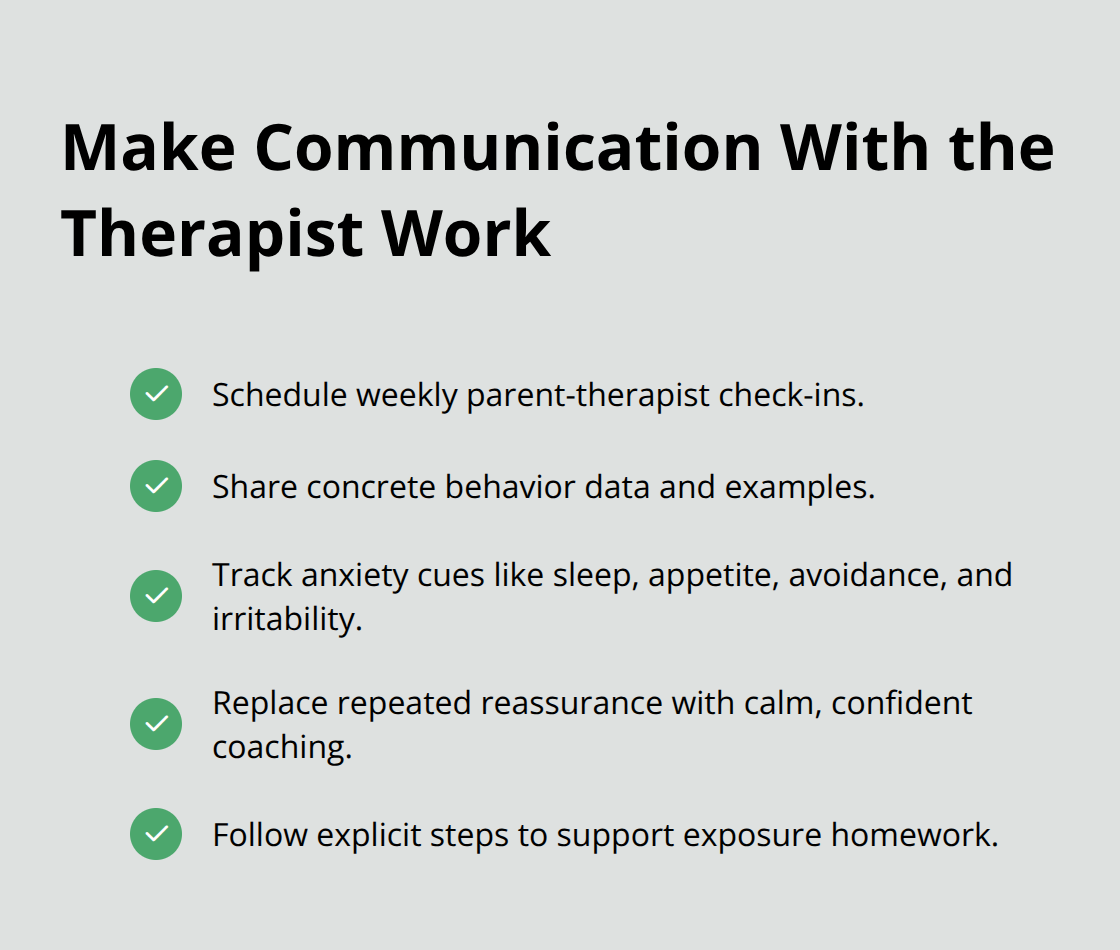
When a parent learns that repeated reassurance actually strengthens anxiety cycles, they gain clarity on why saying “you’ll be fine” doesn’t help. Instead, parents who acknowledge their teen’s discomfort and express confidence in their ability to handle it create psychological safety. The communication channel also needs to address what happens between sessions. If a therapist assigns exposure homework-like attending a school event despite social anxiety-parents need explicit instructions on how to support that exposure without pushing too hard or allowing avoidance.
Teach parents to recognize and respond to anxiety cues
Parents must know when to encourage and when to step back, which is the opposite of what most parents naturally do. This distinction separates effective support from inadvertent reinforcement. When parents spot sleep disruption, appetite changes, or irritability, they respond with calm presence rather than panic. If a parent panics when their teen shows anxiety, the teen’s body interprets that as confirmation that the situation is genuinely dangerous. Parents should learn relaxation techniques like controlled breathing so they can guide their teen through them during anxious moments. They also need to understand how their own stress response influences their teen’s nervous system. Practical tools matter here: apps like Calm and Headspace offer guided practices parents and teens can do together, creating shared coping language. Parents also benefit from reframing anxiety conversations. Instead of asking “Are you worried about school tomorrow?” which invites rumination, they might ask “What’s one thing you did well today?” or suggest a concrete activity like a walk or cooking together that shifts the teen’s focus.
Implement evidence-based strategies parents can use immediately
Research on family-centered anxiety treatment shows that parent-focused approaches can match or exceed adolescent-only cognitive behavioral therapy for anxiety in some cases, particularly when parents learn to reduce accommodation behaviors and model healthy stress management. Parents who stop allowing avoidance-skipping school to avoid social situations or sleeping in the parent’s room to manage nightmares-interrupt the protection trap that feeds anxiety. About 80% of children respond well to parent-involved interventions that teach families to support gradual exposure instead. These strategies work because parents apply them consistently across home, school, and community settings, not just during therapy sessions.
Celebrate progress and manage setback expectations
Recovery is nonlinear. A teen might handle one exposure successfully, then regress during a stressful week at school. Parents who understand that setbacks are normal and part of progress stay engaged instead of becoming discouraged. Celebrating small wins-like a teen attending class despite anxiety, sleeping without nightmares for three nights, or simply talking about their worry instead of avoiding it-reinforces the effort that recovery requires. These celebrations don’t need to be elaborate; specific acknowledgment works best: “I noticed you went to the football game even though you were nervous. That took real courage.” Parents who expect their teen to be completely anxiety-free after a few therapy sessions often become discouraged and disengage. Setting realistic expectations prevents this most common failure point. Understanding that progress happens in increments keeps families motivated through the longer journey of treatment.
Yet knowing what to do and actually doing it under stress are two different challenges. Many parents want to engage fully but face real obstacles-work schedules, transportation barriers, financial constraints, and the stigma that still surrounds mental health treatment. These barriers don’t reflect a lack of commitment; they reflect the practical realities families navigate. Addressing these obstacles directly determines whether parents can sustain the involvement that drives outcomes.
What Stops Parents From Getting Involved
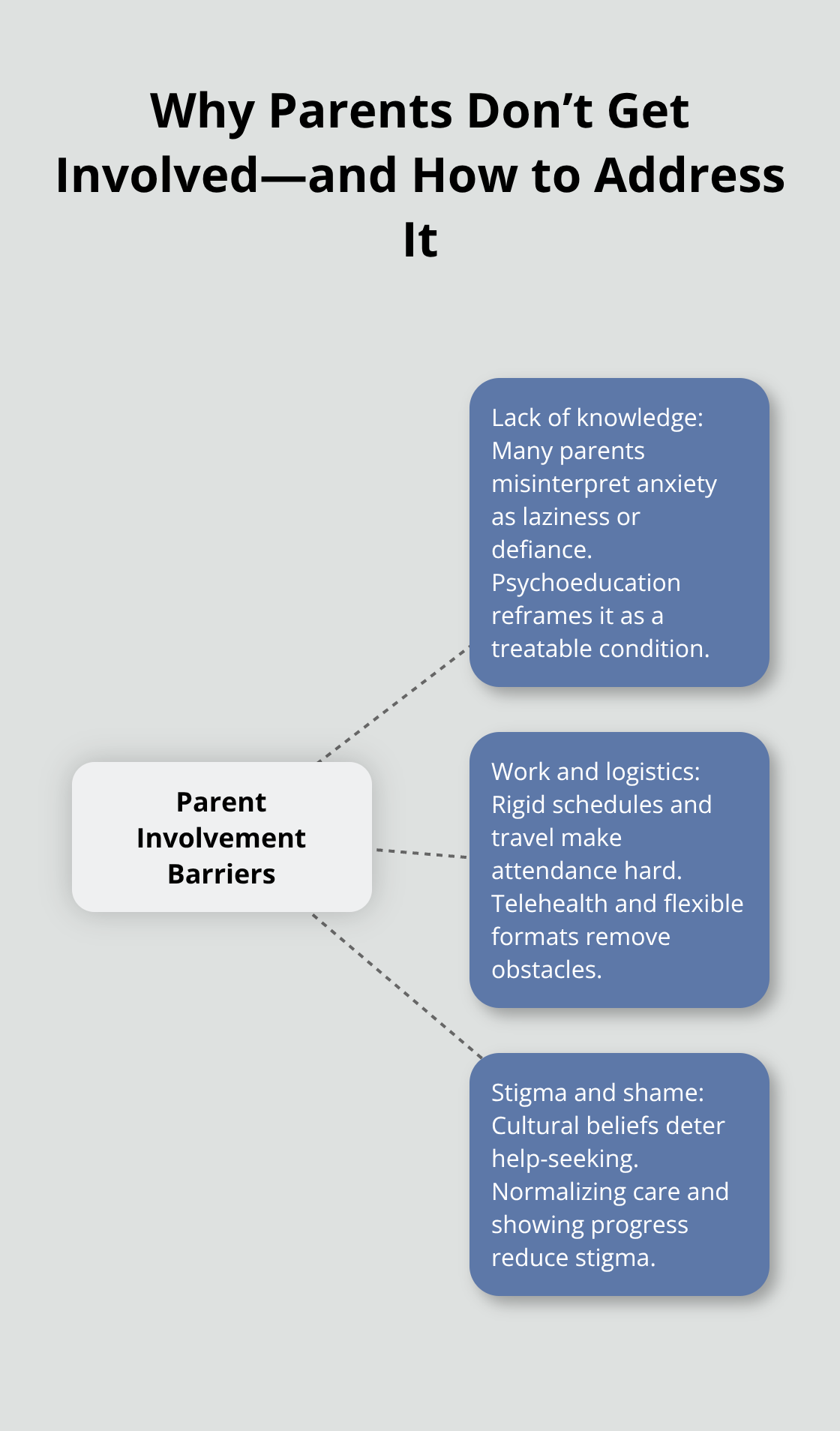
Parents cite three main obstacles when asked why they don’t fully engage in their teen’s anxiety treatment: they don’t understand anxiety well enough to help, their work schedules make attendance impossible, and shame about mental health keeps them from showing up at all. These aren’t excuses. They’re real constraints that treatment programs must address directly.
A parent working two jobs with no paid time off cannot attend weekly in-person therapy sessions, no matter how much they want to. A parent who grew up hearing mental illness was a character flaw won’t suddenly feel comfortable discussing their teen’s panic attacks in a therapist’s office. Understanding what actually blocks parents matters more than assuming they’re unmotivated.
Lack of knowledge about anxiety creates confusion
Most parents don’t understand that anxiety disorders are medical conditions with specific symptoms, not character flaws or attention-seeking behavior. When a teen refuses to attend school because of social anxiety, a parent who doesn’t understand the disorder might interpret this as laziness or defiance. That misunderstanding leads to responses like punishment or forced exposure without professional support, which typically worsens anxiety rather than improving it. Parents need concrete education about what anxiety looks like in their specific teen: sleep disruption, appetite changes, irritability, avoidance of activities they once enjoyed, and physical symptoms like headaches or stomach pain. This information isn’t optional. Research shows that when parents understand anxiety as a treatable condition rather than a personality problem, they shift from shame-based responses to supportive ones. Treatment programs that provide brief psychoeducation sessions specifically for parents see better engagement than those assuming parents already understand. Therapists should explain the protection trap explicitly: when parents accommodate anxiety through allowing avoidance, they accidentally strengthen it. This single insight often shifts how parents respond to their teen’s anxiety.
Work schedules and logistics demand flexible solutions
Telehealth removes the transportation barrier entirely, yet many treatment programs still default to in-person sessions. A parent in a rural area an hour from the nearest therapist office faces genuine obstacles that telehealth eliminates. Work schedules demand flexibility too. Some programs now offer separate parent sessions at different times than teen sessions, so parents don’t need to coordinate schedules. Others allow asynchronous communication where therapists send brief video updates or written summaries that parents review when they have time, rather than demanding real-time participation. These adaptations aren’t inferior to in-person weekly sessions; they’re often more practical for working families. When barriers like transportation, childcare, and work conflicts get addressed through flexible scheduling or virtual options, participation rates increase significantly. Programs that refuse to adapt to family reality lose engaged parents.
Stigma and shame require direct action, not assumptions
A parent who grew up in a household where mental health problems meant weakness won’t suddenly feel comfortable seeking help because a therapist suggests it. Stigma runs deep. Treatment programs that acknowledge this directly and normalize mental health treatment see better family engagement. Therapists can ask parents about their own experiences with mental health growing up, validate the discomfort, and then explain why their teen’s anxiety treatment works differently than what they may have witnessed. Sharing that adolescents experience mental health disorders helps parents understand their teen isn’t uniquely broken. Describing therapy as skill-building rather than fixing a broken mind shifts the frame. When parents see their teen make concrete progress after starting treatment, their own stigma often diminishes. The first step forward sometimes requires the therapist to address the elephant in the room directly: What are you worried people will think if your teen goes to therapy? This honest conversation opens space for parents to move past shame toward action.
Final Thoughts
The evidence proves that teen anxiety family involvement produces measurable, lasting change. Parents who actively participate in treatment become the foundation that makes recovery stick-a 79.5% remission rate at 12-month follow-up happened because families and schools reinforced exposure work between sessions. Without that consistent family layer, teens revert to avoidance patterns and anxiety regains ground.
The barriers parents face-work schedules, transportation, stigma, and lack of understanding-are real but solvable. Flexible scheduling, telehealth options, and direct psychoeducation about anxiety remove the obstacles that prevent engagement. When treatment programs adapt to family reality instead of demanding families adapt to rigid structures, participation increases and outcomes improve.
Taking the first step toward family-centered care means reaching out for professional support. Contact The Teen Center to explore how teen anxiety family involvement can transform your teen’s recovery and strengthen your family’s resilience.