Telehealth has transformed how teens access mental health care, but significant barriers still prevent many adolescents from getting the help they need. Digital divides, lack of privacy, and technology challenges create real obstacles for young people seeking support.
At The Teen Center, we’ve seen firsthand how these hurdles affect the teens we serve. This post shares practical solutions that actually work to remove these barriers and expand access to care.
What’s Stopping Teens From Using Telehealth
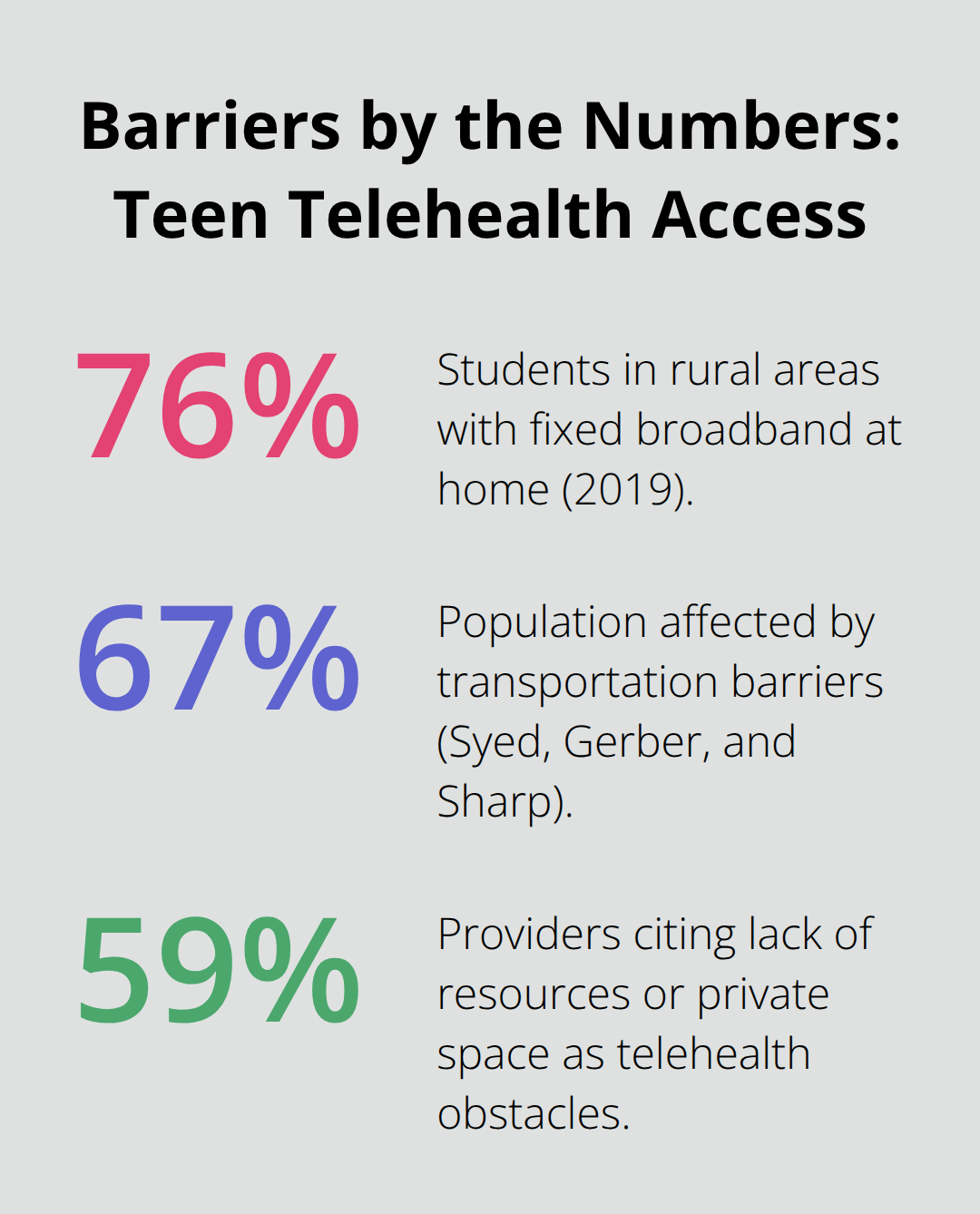
The digital divide remains one of the most stubborn barriers keeping adolescents off video calls with mental health providers. In 2019, some 76 percent of students living in rural areas had fixed broadband internet access at home, which was lower than the percentages living in towns. Even when connection is available, the cost matters. Families paying for multiple streaming services, phone plans, and data overages often can’t justify adding dedicated bandwidth for mental health appointments. Low-income households suffer most. Research from the Syed, Gerber, and Sharp study found that transportation barriers affect roughly 67% of the population, but telehealth only solves that problem if you can actually connect. Without stable internet, a teen in a rural county might wait weeks for an in-person appointment while sitting in a home where the WiFi drops every few minutes.
Device access compounds this problem. Teens without personal smartphones or laptops share family computers, making it nearly impossible to attend a confidential therapy session. Schools have helped close some gaps by distributing devices and hotspots, but those tools come with restrictions-school-issued equipment often blocks access to websites needed for telehealth platforms, leaving teens stuck between two barriers.
Privacy Collapses at Home
The second barrier hits harder than most providers realize. Telehealth assumes a private space exists, but privacy during telehealth sessions remains a serious obstacle for adolescents. Shared walls in apartments mean siblings or parents overhear conversations about depression, anxiety, or trauma. Homelessness eliminates privacy entirely. A teen living in a shelter or car cannot have a confidential conversation with a therapist. Even in stable homes, the logistics fail. A mother works from the kitchen table. A younger sibling plays nearby. A father walks through the bedroom. These aren’t theoretical problems-they’re daily realities that force adolescents to choose between receiving care and protecting their privacy. Clinicians noticed this too. About 59% of providers in the same research highlighted lack of necessary resources, including private space, as obstacles to effective telehealth. The confidentiality issue worsens when billing statements arrive. Explanations of benefits mailed to the home expose sensitive mental health information to guardians, potentially outing a teen’s depression or sexual health concerns before they’re ready to discuss it. State laws vary wildly on this, adding legal complexity that most families don’t understand.
Technology Literacy and Device Failures
Platform usability matters far more than tech companies assume. Among young people who experienced technical issues, 53.5% cited platform instability or poor usability as the primary problem, followed by internet connectivity problems at 43.7%. A teen with limited tech experience might not understand how to unmute themselves, share their screen, or handle a dropped connection. Some platforms require downloads that won’t work on older devices. Others demand parental approval to install.
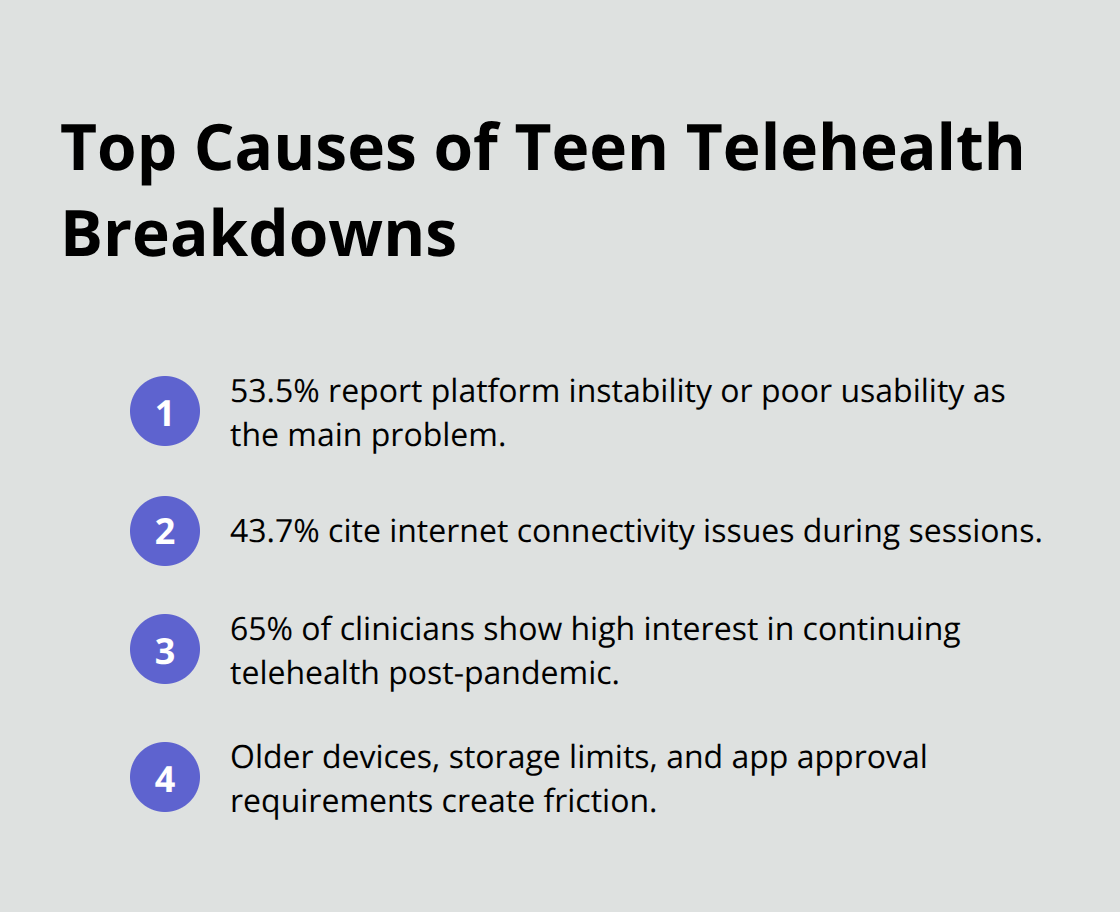
Clinicians report substantial interest in continuing telehealth after the pandemic-65% showed high interest-but that enthusiasm drops when sessions crash or the interface confuses the person trying to use it. Device limitations extend beyond software. An older smartphone with minimal storage won’t run the latest videoconferencing apps. A family computer from five years ago struggles with bandwidth-heavy platforms. Teens without technical support at home have no one to troubleshoot when things break. A simple connection error kills the appointment, and rescheduling means waiting another week or two for the next available slot.
These barriers don’t exist in isolation-they stack on top of each other, creating compounding obstacles that push teens away from care. The real question isn’t whether these problems exist, but how organizations can actually solve them.
How Organizations Are Actually Solving Telehealth Access
The barriers are real, but they’re not insurmountable. Organizations across the country have moved past talking about problems and started building actual infrastructure to connect teens with care. The most effective solutions don’t rely on wishful thinking or expensive overhauls. They work within existing community structures and address the specific obstacles that block adolescents from care.
Creating Telehealth Hubs in Community Spaces
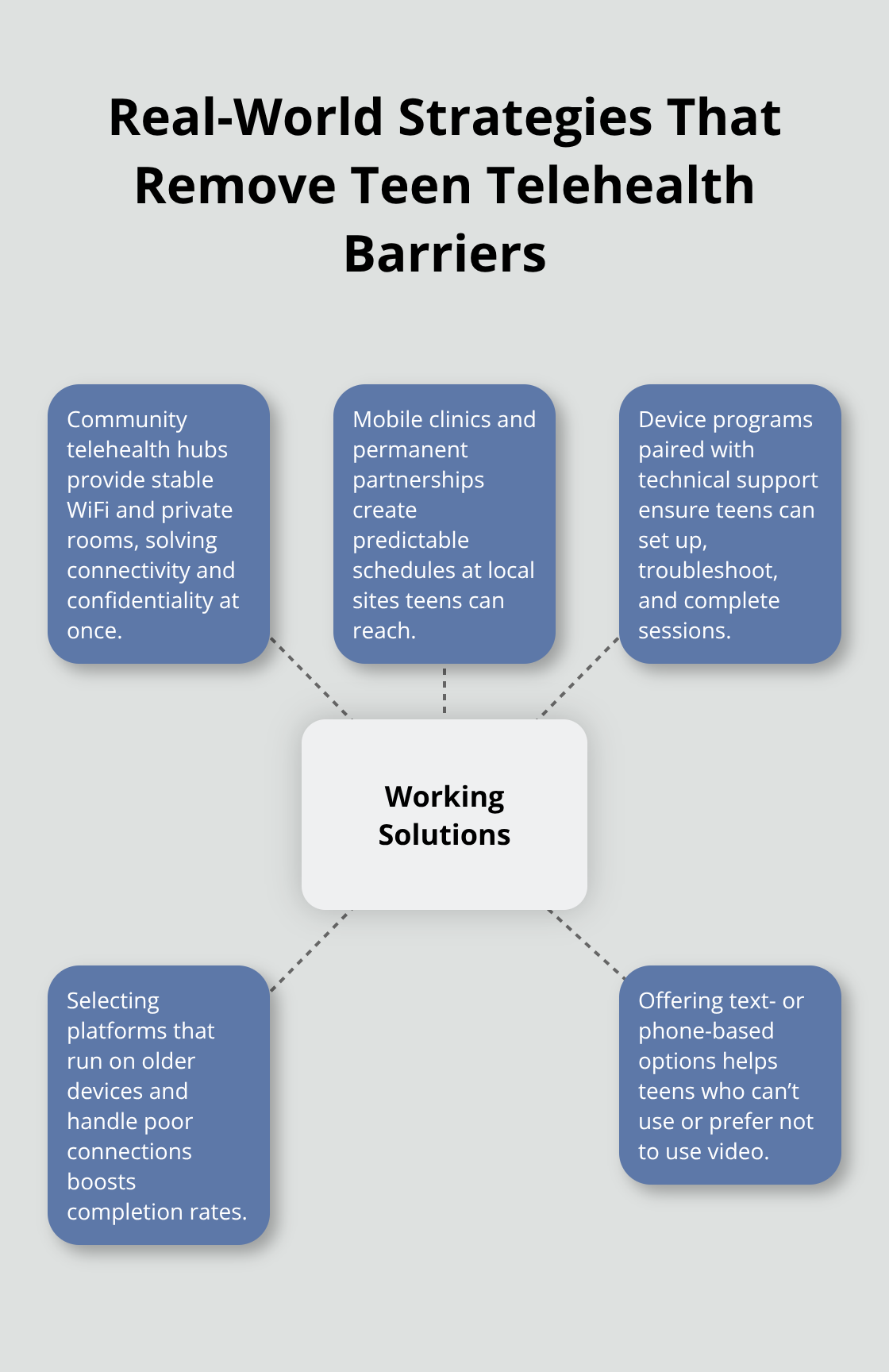
Internet access remains the foundation, and some communities have stopped waiting for broadband companies to fill rural gaps. Libraries, community centers, and schools now function as telehealth hubs where teens attend appointments in dedicated spaces with stable wifi. This approach removes two barriers at once: connectivity and privacy. A teen in a rural county no longer needs to choose between unreliable home internet and zero confidentiality.
Mobile telehealth clinics take this further by bringing providers directly to neighborhoods where access is worst. These aren’t temporary solutions either. Permanent partnerships between health systems and community organizations create recurring telehealth schedules at specific locations, so teens know exactly where to go and when. Schools have proven especially valuable partners, offering unused classrooms and computer labs during non-instructional hours.
Pairing Devices With Technical Support
Research on telehealth adoption during COVID-19 showed that clinicians identified technology access and resources as critical barriers. Organizations that paired device distribution with technical support saw significantly higher engagement. Providing a refurbished laptop or tablet means nothing if a teen doesn’t know how to troubleshoot when the platform crashes.
Technical support lines staffed during evening and weekend hours catch problems before they derail appointments. Some organizations have contracted with local tech support services to handle setup and training, turning what could be a barrier into a brief onboarding process. This combination-equipment plus human support-addresses the reality that adolescents need both tools and guidance to use them effectively.
Selecting Platforms That Actually Work
Platform selection matters enormously. Among young people experiencing technical difficulties, 53.5% cited platform instability or poor usability as the main problem. Organizations that switched to platforms with simpler interfaces and better mobile optimization saw immediate improvements in attendance and completion rates. A good platform doesn’t require a manual. It works on older devices, handles poor connections gracefully, and doesn’t demand parental passwords or app downloads that create friction.
Some organizations have moved toward text-based or phone-based options for teens who struggle with video, recognizing that synchronous video isn’t always the right tool for every adolescent or situation. This flexibility-offering multiple formats rather than forcing all teens into one modality-reflects how real-world solutions adapt to individual needs rather than expecting teens to adapt to rigid systems.
These practical approaches share a common thread: they acknowledge that removing barriers requires coordination across multiple sectors and a willingness to meet teens where they actually are, not where providers assume they should be.
How Telehealth Access Becomes Reality for Underserved Teens
Removing barriers requires infrastructure that actually reaches the teens who face the worst obstacles. Organizations that serve adolescents effectively don’t build one-size-fits-all systems. They create networks designed specifically to address the gaps that prevent rural, low-income, and marginalized teens from connecting with providers.
Statewide Networks Expand Capacity and Reduce Wait Times
Statewide telehealth networks establish consistent access points across regions where in-person mental health services are scarce or nonexistent. When a teen in a county with zero psychiatrists can access a therapist through a coordinated network, the entire equation changes. A teen in a rural region receives the same caliber of care as one attending in-person sessions in an urban center.
Statewide networks also reduce appointment wait times dramatically. When providers can see patients across geographic boundaries, capacity expands immediately. A clinician in one region can absorb overflow from another, and scheduling becomes flexible rather than constrained by local supply. The infrastructure investment pays dividends through higher completion rates and shorter gaps between sessions.
Device Programs Connect Teens to Specialized Care
Device accessibility programs paired with telehealth networks eliminate a critical friction point. Providing refurbished laptops or tablets to teens without personal devices addresses the immediate barrier, but the real impact comes from coupling equipment distribution with statewide coordination. When a teen receives a device through a program in their county, they can use it to connect with providers anywhere in the network, not just locally.
This flexibility matters enormously for adolescents with specialized needs or those requiring specific therapeutic approaches. A teen needing trauma-focused therapy can work with a clinician who specializes in that modality, even if that provider works three hours away. Equipment alone fails without support-pairing devices with technical assistance ensures teens can actually use what they receive.
Flexible Scheduling Fits Teen Life
Flexible appointment scheduling across multiple time zones and evening hours accommodates the reality of teen life. Many adolescents work part-time jobs, attend school, or have caregiving responsibilities. Traditional mental health scheduling assumes availability during business hours, which excludes huge segments of the teen population. Networks offering appointments from 7 a.m. to 9 p.m. across multiple days capture appointments that would otherwise be impossible to schedule.
Research during COVID-19 showed that higher attendance rates during telehealth periods suggest adolescents engage more consistently when appointments fit their actual schedules rather than forcing them to rearrange their lives around provider availability. Scheduling flexibility transforms telehealth from a convenience into a genuine access solution.
Coordinated Care Prevents Fragmentation
Coordinated care systems prevent the fragmentation that plagues adolescent mental health. When a teen receives medication management from one provider, therapy from another, and academic support from a third, communication gaps create dangerous inefficiencies. A statewide network where providers access the same clinical records and coordinate treatment planning ensures that a teen’s care moves in one direction rather than spinning in circles across disconnected systems.
This integration (shared records, aligned treatment goals, regular provider communication) transforms how adolescents experience mental health support. Teens no longer repeat their stories to multiple providers or receive conflicting advice about medication and therapy. Coordinated networks treat the whole person rather than isolated symptoms.
Final Thoughts
The barriers preventing adolescents from accessing telehealth are substantial, but organizations willing to build real infrastructure can dismantle these obstacles systematically. Community partnerships that provide reliable internet, device programs paired with technical support, and platforms designed for actual usability transform telehealth from a theoretical solution into a working reality for underserved adolescents. Statewide networks change the equation entirely when a teen in a county with no psychiatrists connects with a specialized provider through coordinated care.
Evidence shows that telehealth works when organizations address the specific obstacles that block adolescents from care. Higher attendance rates during telehealth periods demonstrate that teens engage more consistently when barriers fall away, and clinicians report sustained interest in continuing telehealth because they see real results. Young people themselves rate telehealth positively when the infrastructure supports them rather than creating new problems.
We at The Teen Center understand that removing telehealth access barriers for adolescents requires more than good intentions. Our statewide network combines intensive outpatient programs, individual and family therapy, medication management, and crisis support through both in-person and telehealth options, ensuring that geography and circumstance never determine whether a teen receives help. Learn more about how we’re expanding access at The Teen Center.