
Teen anxiety is at an all-time high, with the American Psychological Association reporting that nearly 1 in 3 adolescents experience an anxiety disorder. School counselors are often the first line of defense, yet they’re stretched thin with caseloads that average 482 students per counselor.
At The Teen Center, we believe that school counselors can’t solve this alone. When schools partner with specialized mental health providers, anxious teens get the targeted support they actually need.
Understanding Teen Anxiety in Schools
How Widespread Is Teen Anxiety Really?
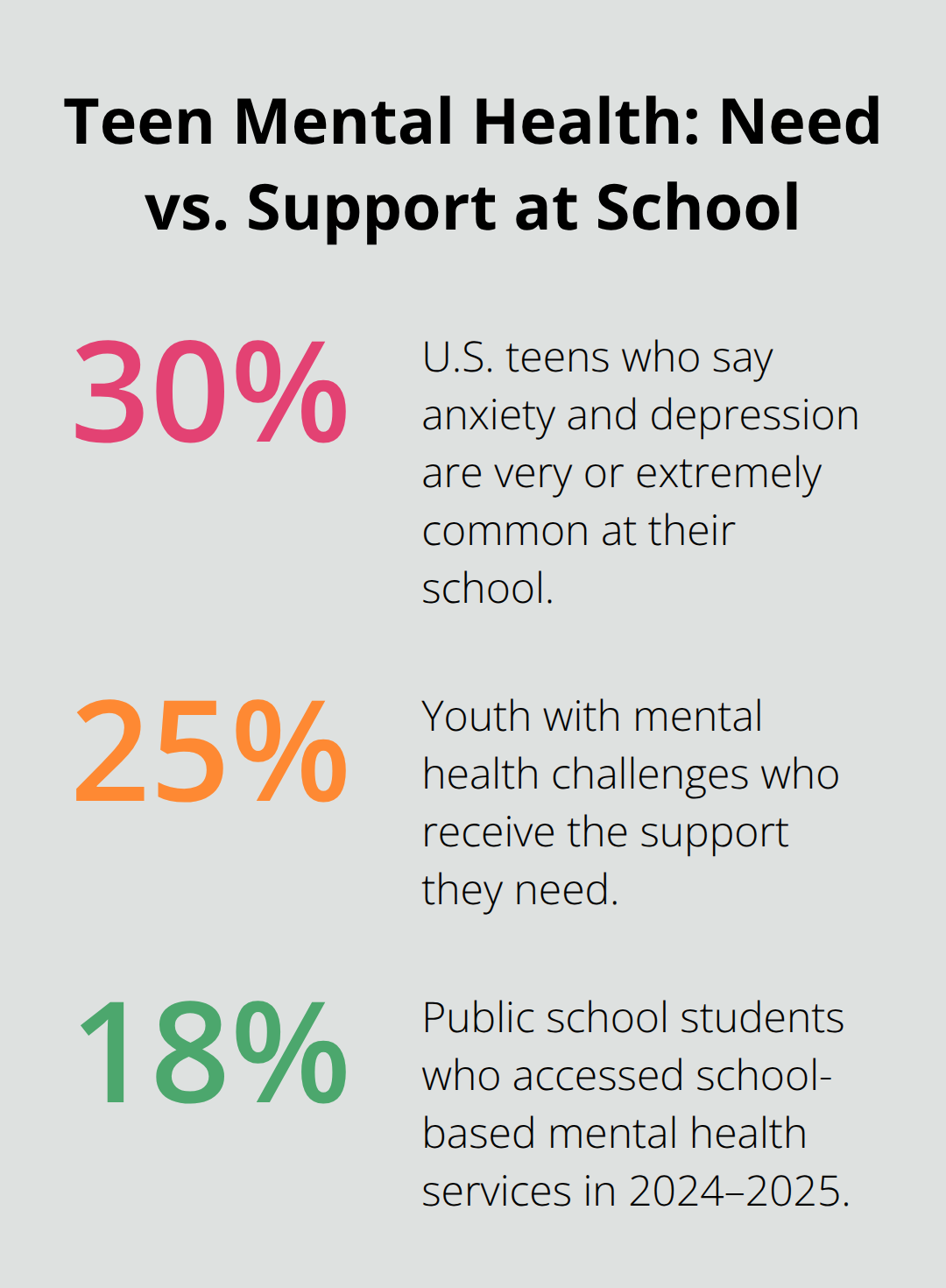
Teen anxiety isn’t a niche problem affecting a small percentage of students. According to the CDC, nearly half of all students feel persistently sad or hopeless, a clear indicator of widespread mental health struggles. The Pew Research Center reported in March 2025 that 30% of U.S. teens describe anxiety and depression as extremely or very common at their school, with girls significantly more affected than boys (39% say it’s more common among girls, while only 5% say it’s more common among boys). The real crisis emerges when looking at treatment access: only about 25% of youth experiencing mental health challenges receive the support they need, according to research in Frontiers in Psychiatry. In the 2024-2025 school year, 18% of public school students accessed school-based mental health services, meaning roughly 82% of students either don’t need support or aren’t receiving it despite struggling. School counselors witness this gap daily, but managing 482 students per counselor on average makes early identification difficult.
What Actually Triggers Anxiety in Teens
The stressors teens face at school are specific and measurable. Academic pressure ranks high, with perfectionism, test anxiety, and fear of poor performance driving significant distress. Peer relationships create another layer: bullying affects 22% of teens according to Pew Research, while social anxiety manifests as fear of judgment, withdrawal from group activities, and avoidance of classroom participation. School attendance itself becomes a trigger for some teens, showing up as physical symptoms like headaches or stomachaches when school is mentioned. Trauma, family stress, and past experiences compound these school-specific stressors. The Pew data also reveals gender differences in how anxiety appears: girls report higher rates overall, yet boys face different pressures around physical aggression and substance use that create their own anxiety patterns. Understanding which specific stressor affects each teen matters enormously because it determines whether a counselor should address test anxiety through coping strategies, social anxiety through exposure work, or attendance avoidance through family collaboration.
The Academic and Social Cost
Anxious teens don’t just feel bad; their performance suffers measurably. School avoidance and chronic absenteeism reduce classroom time and learning opportunity. Anxiety consumes cognitive resources that should go toward focus and retention, causing academic performance to decline. Socially, anxious teens withdraw from peers, skip group activities, and miss leadership opportunities that build confidence and resilience. The isolation reinforces the anxiety cycle. Teachers report increased concerns about students with anxiety, depression, and emotional dysregulation, with 61% of school staff noting heightened worry in 2024-2025. This staff concern provides valuable data for counselors because it signals which students need screening, yet without systematic universal screening in place, many anxious teens remain invisible until their grades crash or their attendance becomes a truancy issue. School counselors recognize these warning signs, but identifying anxious students represents only the first step toward intervention.
What School Counselors Actually Do to Spot and Support Anxious Teens
How School Counselors Identify Anxiety
School counselors identify anxiety through direct observation and systematic screening, not guesswork. They watch for mood changes, declining grades, attendance drops, physical complaints like headaches or stomachaches, avoidance of specific classes or social situations, and family stress reported by students. The American School Counselor Association notes that counselors also recognize behavioral shifts: withdrawn participation in group work, perfectionism that paralyzes rather than motivates, and procrastination tied to performance fear.

Some schools now implement universal behavioral health screenings that reach all students. These screening tools help counselors catch anxious teens early, before anxiety spirals into chronic absenteeism or academic failure.
Short-Term Interventions School Counselors Provide
Once identified, school counselors deliver short-term, targeted interventions rather than long-term therapy. They teach coping strategies grounded in evidence-based therapy for adolescent anxiety and mindfulness, helping anxious teens identify triggers and develop in-the-moment responses. Counselors also provide crisis intervention when anxiety escalates, preventing students from dropping out during acute episodes. The American School Counselor Association emphasizes that counselors handle case management, referrals to outside providers, family coordination, and 504 plan advocacy-work that positions them as connectors between students and specialized care. In 2024-2025, 73% of schools still rely on counselors to deliver mental health services, down from 83% in 2021-2022, meaning counselors remain the backbone of school-based anxiety support despite growing demand.
The Capacity Crisis That Limits What Counselors Can Do
The hard truth about school counselor capacity is this: it’s broken. With 482 students per counselor on average, meaningful intervention becomes mathematically impossible. In 2024-2025, 28% of administrators reported understaffing with mental health providers, and only about half of schools felt they could effectively serve all students needing support. Counselors fragment their time across competing demands, making it difficult to provide the intensive follow-up that anxious teens need. Telehealth expanded to 22% of schools as of 2024-2025, offering some relief by reducing travel barriers, but it doesn’t solve the fundamental shortage. Federal funding collapsed when pandemic-era ESSER funds ended and the Bipartisan Safer Communities Act’s $1 billion for school mental health providers was canceled in April 2025. Schools now rely on district funds covering 58-65% of mental health costs, with partnerships covering 38-44%, creating unstable, stretched-thin programs.
Why Specialized Providers Fill the Gap
School counselors excel at early identification, brief intervention, and connecting students to appropriate care. However, they cannot provide the intensive, individualized treatment that many anxious teens require to actually recover. This limitation isn’t a failure of counselors-it reflects the structural reality of their role. Specialized mental health providers step into this gap, offering the longer-term, evidence-based therapy that school counselors identify as necessary but lack time to deliver. When schools partner with providers who understand adolescent anxiety and trauma, anxious teens access the targeted support they actually need. The collaboration transforms what school counselors can accomplish: they identify and stabilize students, while specialized providers build the skills and resilience that lead to lasting change.
Building Effective Partnerships Between Schools and Specialized Providers
How School Counselors and Outside Providers Complement Each Other
When school counselors connect anxious teens to specialized mental health providers, outcomes shift dramatically. School counselors identify and stabilize students during the school day, while providers deliver the intensive treatment that builds lasting resilience. This partnership works because each side performs what it does best. According to the American School Counselor Association, counselors excel at brief intervention, crisis response, and connecting students to community resources. Specialized providers handle the longer-term therapy that anxious teens need to recover.

The collaboration removes the false choice between school-based support and community care. In 2024-2025, 67% of schools referred students for care outside the school, signaling that schools recognize their limitations and actively seek external partners. When these referrals connect to providers who understand adolescent anxiety and communicate back to the school, anxious teens stay engaged with treatment instead of falling through cracks.
Removing Barriers to Sustained Treatment
Anxious teens often struggle to access care due to travel barriers, appointment availability, or family coordination challenges. Telehealth expanded to 22% of schools in 2024-2025, and specialized providers offering remote sessions remove one major barrier to sustained treatment. The Teen Center delivers specialized, evidence-based mental health care for adolescents ages 12 to 17, offering intensive outpatient programs, individual and family therapy, medication management, and crisis support both in person and via telehealth. This model matters because it addresses the logistical obstacles that prevent teens from completing treatment. Statewide telehealth access means students in rural or underserved areas can connect with providers without lengthy travel times.
Creating Clear Referral Pathways and Communication Structures
Effective coordination between school counselors and outside providers requires specific infrastructure, not just good intentions. Schools should establish clear referral pathways so counselors know exactly which providers handle which types of anxiety and how to initiate contact. Written agreements or memoranda of understanding clarify confidentiality rules, communication frequency, and how providers share progress updates with school staff. The American School Counselor Association emphasizes that counselors coordinate 504 plans and IEP accommodations based on provider input, ensuring students receive classroom supports aligned with their treatment. Assign one staff member at the school to serve as the liaison between counselors and outside providers, managing release forms, scheduling updates, and ensuring nothing slips. Without this coordination layer, referrals become one-way transactions where students leave school for therapy but counselors never hear about progress or treatment goals.
Strengthening Treatment Through Family and School Involvement
Group-based interventions increased to 65% of schools in 2024-2025, and family interventions to 43%, reflecting recognition that anxiety treatment works best when families and schools reinforce what providers teach. Try asking providers whether they offer parent coaching, since anxious teens recover faster when parents understand how to support progress at home without accommodating anxiety in ways that reinforce it. When providers, counselors, and family interventions align their approach, teens receive consistent messages about managing anxiety across all settings. This three-way partnership accelerates recovery and prevents the isolation that often deepens anxiety.
Final Thoughts
School counselor teen anxiety support works best when schools stop trying to solve the problem alone. The data is clear: 30% of teens experience anxiety at school, yet counselors manage 482 students each. This gap between need and capacity demands partnership, not because counselors fail but because the structural reality requires outside support.
Real coordination matters more than good intentions. Schools that establish clear referral pathways, assign a liaison between counselors and providers, and ensure regular communication see better outcomes. When parents understand how to support their teen’s treatment at home and providers share progress updates with school staff, teens recover faster and stay engaged with school. The Teen Center delivers specialized, evidence-based mental health care for adolescents ages 12 to 17, offering intensive outpatient programs, individual and family therapy, medication management, and crisis support both in person and via telehealth.
The shift toward integrated student wellness programs reflects a simple truth: anxious teens need counselors who identify them early and specialized providers who deliver the intensive treatment that builds lasting resilience. Schools that formalize agreements with providers, clarify confidentiality rules, and align 504 plan accommodations with treatment goals create the conditions where anxious students actually recover and thrive academically.